Heel Taps: Form, Benefits & Variations for Women
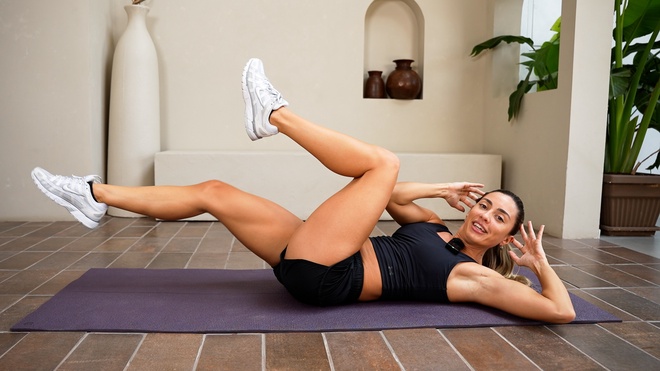
Heel taps: lie on back, knees bent, lift shoulders, slide hands alternately to tap heels. Targets obliques and core through lateral flexion. Keep lower back pressed into mat.
Heel Taps: Form, Benefits & Variations for Women
I used to skip this one. Genuinely. I would look at heel taps on a workout plan, see the word "beginner," and assume they were filler between the exercises that actually mattered. Just lying on your back, sliding your hands toward your feet. How hard could that be.
Then Sophie Jones programmed them in a descending ladder format during one of her Core Sweat sessions. Ten reps, then leg raises, then nine reps, then leg raises, counting down to one. By rep six of the first set, my obliques were on fire in a way that no crunch, no Russian twist, no plank had ever produced. The burn was not in the front of my abs. It was deep along the sides of my waist, a lateral squeeze that felt like someone was wringing out a towel from my ribs to my pelvis.
That is what heel taps actually train. Lateral flexion of the spine. Your obliques shortening on one side while lengthening on the other. It is the movement pattern you use every time you lean sideways to pick something up, reach into a back seat, or twist to check a blind spot. A 2022 systematic review on core muscle activation confirmed that lateral flexion exercises produce significantly higher oblique EMG activity than standard sagittal-plane movements like crunches. Nine occurrences across five workouts in our library. Two certified trainers. Sophie Jones programs them in weight loss circuits and dedicated core sessions. Lianna Brice includes them in her Pilates Burn series. Both use almost identical cues: belly button into the floor, squeeze the obliques, side to side.
Total Body Conditioning: Workout 7 - Core
Sophie Jones
How to Do Heel Taps
Lie on your back with your knees bent and feet flat on the floor, roughly hip-width apart. Your heels should be close enough to your glutes that you can almost touch them when you reach sideways. Sophie Jones: bend the knees, feet flat to the floor. The closer your feet are to your hips, the easier the reach. The farther away, the harder your obliques have to work.
Lift your head and shoulders just enough to clear your shoulder blades off the mat. Sophie: my upper body is slightly pressed off of the mat. This is not a full crunch. You are lifting just enough to create tension in the abdominals. Keep your gaze toward the ceiling or slightly forward to protect your neck.
Press your lower back firmly into the floor and tuck your pelvis slightly. Sophie: belly button pushed into the floor, tucking my pelvis under. This pelvic tuck eliminates the gap between your lumbar spine and the mat, which protects your back and activates the transversus abdominis before the movement even begins.
Slide one hand down the side of your body toward your heel, reaching as far as you can. Sophie: sliding down the side, I'm trying to reach as far as I can, squeezing in my obliques. Lianna Brice: take one hand out towards your heel and start to just tap it to the side. The reach comes from lateral flexion of the trunk, not from arm movement. Your hand is just a target. The oblique on that side does the pulling.
Return to centre and reach the opposite hand toward the other heel. Lianna: try to keep your shoulders at around the same height. Exhale as you reach. Sophie: as you're breathing out, really push that core down. One complete cycle, left heel plus right heel, counts as one rep. Sophie: two taps is one.
Muscles Worked
Primary
Internal and external obliques
The obliques are the entire point of the heel tap exercise. When you slide toward your right heel, the right oblique shortens concentrically while the left oblique lengthens eccentrically. Then you reverse it. A systematic review of core muscle activation during therapeutic exercises found lateral flexion movements elicit significantly higher oblique EMG activation compared to sagittal-plane exercises like crunches. Sophie Jones gets right to it: squeezing into them obliques, side to side. Lianna Brice describes it as a lateral crunch: in crunch position, reaching one hand laterally to tap the same-side heel.
Transversus abdominis
The deepest abdominal muscle. It wraps around your midsection like a corset and acts as the foundation for every other core movement. Supine heel taps require you to press your lower back into the mat throughout, which is the textbook transversus abdominis activation cue. Sophie: pushing that tummy button into the floor. Without this engagement, the lower back arches and the obliques cannot fire efficiently.
Rectus abdominis
Holds the shoulder lift isometrically while the obliques do the lateral work. It does not flex the spine further during the movement. It simply maintains the crunch position so you can reach side to side. Sophie: lift that upper body up. This is a static role, not the primary mover, which is why heel taps burn differently than crunches. The rectus is supporting, not starring.
Secondary
Hip flexors (illiopsoas)
Stabilize the bent-knee position and help hold the pelvis in the tucked position throughout the set. Not a major contributor, but they engage to keep the legs from shifting while your torso moves laterally.
Upper back (thoracic extensors)
Multiple instances in our database list upper_back as a targeted body part. The upper back muscles support the shoulder lift and control the lateral sliding motion. They prevent the upper body from collapsing back onto the mat between reps.
Why this matters in perimenopause
The obliques and transversus abdominis are critical for trunk stability during perimenopause. Hormonal changes reduce muscle quality across the board, but the deep lateral stabilizers often weaken first because they are the muscles most people never train directly. Crunches target the rectus. Planks target anti-extension. Heel taps target the lateral system that keeps your spine stable when you carry groceries, lean over a desk, or twist to grab something. The ACSM Exercise is Medicine guidelines for perimenopausal women emphasize core strengthening, and lateral core work fills a gap that forward-focused exercises miss.
Coach's Tips
"Sliding down the side, I'm trying to reach as far as I can, squeezing in my obliques." Sophie Jones cues this in almost every heel tap set. The key word is squeezing. Your hand sliding toward your heel is a side effect of the oblique contracting, not the goal itself. If you reach with your arm without contracting your side waist, you are cheating the movement. Think about shortening the distance between your lowest rib and your hip bone on the reaching side.
Sophie Jones
"Belly button pushed into the floor, tucking my pelvis under." Sophie gives this cue at the start of every set for a reason. The pelvic tuck eliminates the lumbar arch and activates the transversus abdominis before the first rep. Without it, your lower back will take over and your obliques never fully engage. Press your lower back into the mat hard enough that you could not slide a hand underneath.
Sophie Jones
"Try to keep your shoulders at around the same height." Lianna Brice catches a common cheat here. When you reach for one heel, the opposite shoulder tends to lift higher, turning the movement into a rotation instead of a lateral flex. Both shoulders should stay at the same level above the mat. The movement comes from your trunk bending sideways, not your shoulders twisting.
Lianna Brice
"Get them pinches in the side, and pushing down at the same time." Sophie describes the dual action: lateral flexion (the pinch) combined with abdominal bracing (pushing down). These two things have to happen simultaneously. If you only pinch without pushing down, your back arches. If you only push down without pinching, you are just doing an isometric hold. The heel tap exercise lives in the overlap of both.
Sophie Jones
"Don't strain your neck, just lift that upper body off the floor." Sophie repeats this safety cue across multiple workouts. The head and shoulder lift should come from your abdominals, not from pulling your chin toward your chest. If your neck hurts, your head is too far forward. Look at the ceiling. Let the abs do the lifting. If neck strain persists, rest your head back down and do the lateral reaches from flat. You will still hit the obliques.
Sophie Jones
Move your feet closer to your glutes to reduce the distance you need to reach. This is the easiest modification and the one I recommend first. When your heels are 6 inches from your hips, the supine heel taps become achievable for anyone. As you get stronger, walk your feet further away. An extra 3 inches of distance means significantly more oblique contraction required to complete the tap.
Sophie Jones
Why This Matters for You
I program heel taps for nearly every woman in perimenopause I work with, and it is not because they are easy. It is because they hit the obliques in a way nothing else does without putting stress on the spine.
Here is what happens to your lateral core during perimenopause. Estrogen decline reduces muscle protein synthesis across all skeletal muscle, but the deep lateral stabilizers suffer disproportionately because most women never train them directly. Your rectus abdominis gets crunches. Your erectors get back extensions. Your obliques get... nothing. They weaken quietly, and the first sign is usually lower back pain during one-sided tasks: carrying a toddler on one hip, hoisting groceries from a car boot, leaning over a counter.
A systematic review on exercise and perimenopausal syndrome found that targeted resistance training improved core strength and menopausal symptom management. The heel tap exercise qualifies as targeted resistance training for the obliques. Lateral flexion under controlled conditions, spine supported, no external load. The ACSM Exercise is Medicine fact sheet on menopause specifically recommends core-strengthening exercises as part of a comprehensive perimenopause fitness programme.
There is a practical benefit too. The supine position means zero balance demand. If you are dealing with perimenopause-related fatigue and the idea of standing exercises feels like too much, you can lie on the floor and work your obliques for three minutes. Sophie Jones programs them in beginner weight loss workouts. The entry barrier is essentially zero. The ceiling is as high as you want to push it.
Variations & Modifications
Close-Feet Heel Taps
lowMove your feet as close to your glutes as possible. The shorter reach means less oblique contraction needed to tap the heel. This is where beginners should start. Focus on form: belly button pressed down, shoulders lifted evenly, slow tempo. Once you can complete 20 reps without your lower back lifting off the mat, move your feet further out.
Extended Heel Taps
mediumWalk your feet further away from your body so your knees are at roughly a 90-degree angle or wider. Sophie Jones programs this as the standard position in her intermediate workouts. The added distance forces a deeper lateral crunch to reach the heel. Some sessions you will not quite reach. That is fine. The effort to reach is what fires the obliques, not the contact.
Core Ladder Heel Taps
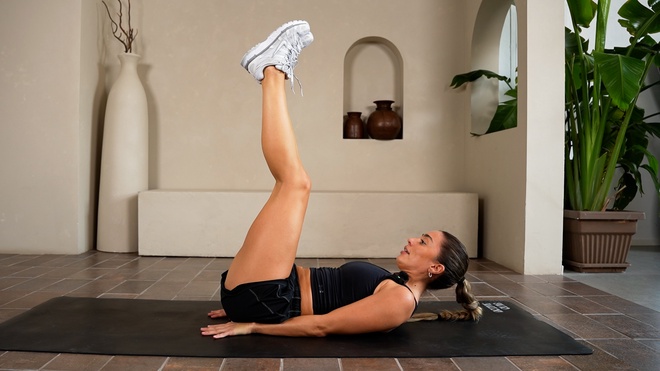
medium-highFrom Sophie Jones' Core Sweat workout: 10 heel taps, then leg raises, then 9 heel taps, then leg raises, descending all the way to 1. The ladder format keeps the obliques under sustained tension for several minutes without rest. This is the hardest heel tap variation in our library. The final few reps at the bottom of the ladder, when your core is already exhausted, reveal exactly how much oblique endurance you have built.
Weighted Heel Taps
medium-highHold a light dumbbell in each hand to add resistance to the lateral flexion. The extra load forces the obliques to contract harder against gravity. Start light, 1 to 2 kg. The movement pattern is identical. The tendency to rotate increases with weight, so keep Lianna's cue front of mind: shoulders at the same height. If you catch yourself twisting, drop the weight.
Benefits
Targeted oblique work without spinal compression
Heel taps train the obliques through lateral flexion while your spine stays supported against the floor. Unlike standing side bends, there is no axial load pressing down on your vertebrae. Unlike Russian twists, there is no spinal rotation under load. The mat supports your lumbar spine throughout. Research on core muscle activation found lateral flexion exercises produce higher oblique EMG activity than crunches while keeping compressive forces low. For anyone with a sensitive lower back, this is a significant advantage.
Deep transversus abdominis activation
The pelvic tuck that every trainer cues at the start is a transversus abdominis activation drill on its own. Maintaining that tuck while moving laterally forces the deepest core layer to stay engaged throughout the entire set. Sophie Jones: pushing that tummy button into the floor. A systematic review of trunk muscle activation confirmed that exercises combining isometric bracing with dynamic movement produce superior deep core engagement. Heel taps do both simultaneously.
Builds the lateral stability gap most people ignore
Most core routines focus on flexion (crunches), extension (back raises), and anti-rotation (planks, bird dogs). Lateral flexion is the missing pattern. You use it when you lean over to grab a heavy bag, reach across a car to buckle a child in, or bend sideways to pick something off the floor. Your obliques stabilize your entire torso during these asymmetric loads. The heel tap exercise fills the lateral gap that forward-focused core training leaves wide open.
Accessible for any fitness level
Foot position is the volume dial. Feet close to glutes: easy. Feet far away: hard. Add a dumbbell: harder. Stack it in a descending ladder: brutal. Two certified trainers in our library program supine heel taps across beginner weight loss circuits, intermediate full-body conditioning, and Pilates series. The exercise scales without changing a single thing about the form. Your obliques do not know whether you are a beginner or advanced. They only know the distance between your hand and your heel.
Common Mistakes to Avoid
Lower back lifting off the mat
Sophie Jones: belly button pushed into the floor, tucking my pelvis under. If your lower back arches, the transversus abdominis has disengaged and your hip flexors are taking over. Before every set, press your lumbar spine into the mat. You should not be able to fit a hand between your back and the floor. If you lose the contact during reps, pause, retuck, and continue.
Pulling on the neck to reach further
Sophie: don't strain your neck, just lift that upper body off the floor. The shoulder lift comes from your upper abs, not your cervical spine. If your chin is pushing toward your chest, you are neck-pulling. Look straight up at the ceiling. Place your tongue on the roof of your mouth to relax the neck flexors. The reach happens at your obliques, not at your head.
Rotating the torso instead of laterally flexing
Lianna Brice: try to keep your shoulders at around the same height. Rotation means one shoulder is twisting higher than the other. That turns a lateral flexion exercise into a poorly executed crunch variation. Both shoulders stay level. Both stay lifted the same amount. The movement is purely side to side, not twisting.
Reaching with the arm instead of the trunk
Sophie: get them pinches in the side. If you extend your arm without bending your torso, you are just waving at your ankle. The hand moves because the trunk bends. Focus on shortening the space between your ribs and your hip on the reaching side. The pinch in your side waist tells you the oblique is doing the work.
Workouts Featuring This Exercise
Join women building lateral core strength with 2 certified trainers across 5 workouts
Frequently Asked Questions
Related Exercises
Crunches
Crunches train spinal flexion. Heel taps train lateral flexion. Together they cover two of the four core movement patterns. Program them in the same circuit: crunches first for rectus, heel taps second for obliques.
Bicycle Crunches
Bicycle crunches combine flexion with rotation. Heel taps use lateral flexion without rotation. If twisting bothers your back, heel taps are the oblique alternative that keeps your spine in a safer plane.
Leg Raises
Sophie Jones pairs heel taps with leg raises in her Core Ladder workout, alternating between them in a descending rep scheme. Leg raises target the lower abs. Heel taps target the obliques. The combination covers the full abdominal wall.
Dead Bug
Both are supine core exercises that keep the lower back pressed into the floor. Dead bugs train anti-rotation and coordinated limb movement. Heel taps train lateral flexion. Pair them for a complete floor-based core session with zero spinal compression.
Russian Twist
Russian twists use rotation to target the obliques. Heel taps use lateral flexion. If you have lower back sensitivity, heel taps are often the safer choice because the spine stays supported against the mat throughout.
This exercise helps with
Get heel taps in a guided workout
Access 5 workouts featuring this exercise, plus personalized plans from Dr. Wellls.
Join women building lateral core strength with 2 certified trainers across 5 workouts
Your membership funds independent women's health research