Plank Shoulder Taps: How-to, Benefits & Variations
Plank shoulder taps: from a high plank, tap opposite shoulder alternating sides. Trains anti-rotation core stability, shoulders, and arms. Keep hips level. Widen feet for stability.
Plank Shoulder Taps: How-to, Benefits & Variations
Three things happen the moment you lift one hand off the floor in a plank. Your body wants to rotate toward the empty side. Your opposite hip wants to dip. And your deep core stabilizers have about 200 milliseconds to prevent both.
That is what a plank with shoulder taps actually trains. Not your shoulders. Not your arms. Your ability to resist rotation under load. Anti-rotation is the technical term. In practice, it means your transversus abdominis, your internal obliques, and your multifidus all fire simultaneously to keep your torso locked in place while one arm moves.
I pulled the data from our workout library. Eleven occurrences across six workouts. Four certified trainers. Linda Chambers programs them in her Back Health series for spinal stability. Sophie Jones uses them in muscle tone circuits and glow-up challenges. Natalia Gunnlaugs drops them into HIIT warm-ups. Beth Hannam puts them in bodyweight challenges. Every single trainer says some version of the same thing: keep your hips still. That is the entire exercise. Everything else is setup.
Rise and Shine: Workout 9
Sophie Jones
How to Do Plank Shoulder Taps
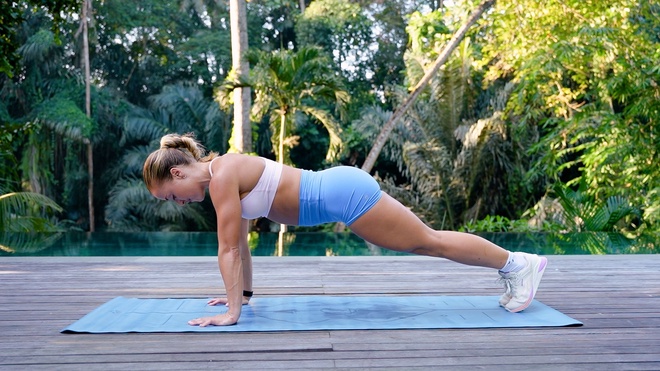
Start in a high plank position with hands stacked directly under your shoulders. Feet wide for stability. Beth Hannam: hands stacked directly under our shoulders, tuck that pelvis under. The tucked pelvis is critical. It prevents your lower back from arching and preloads your core before the movement even starts.
Brace your core hard. Linda Chambers describes it as feeling those internal, deep internal anti-rotational stabilizers really kick in. Draw your belly button toward your spine. Sophie Jones: I'm really trying to draw my belly button in towards my spine. This is not a gentle engagement. You are bracing like someone is about to push you sideways.
Slowly lift one hand off the floor and tap the opposite shoulder. Linda Chambers: the goal here is to keep your body steady and solid, the absolute minimal rotation. The hand travels in a straight line from floor to shoulder and back. No swinging. No rushing.
As you return your hand to the floor, transfer the weight into that palm before switching sides. Linda cues this explicitly: as you put your hand back down on the floor, transfer the weight into that hand. Slamming your hand down creates instability. Controlled placement keeps the chain of tension intact.
Alternate sides. Breathe steadily. Linda again: I cannot stress enough how important it is to do these exercises slowly. Speed is the enemy of this movement. The slower you go, the longer your core has to fight rotation, and the harder it works.
Muscles Worked
Primary
Transversus abdominis and internal obliques (deep core)
These are the muscles that actually make plank shoulder taps work. The moment one hand lifts off, your body becomes a three-point structure fighting rotational collapse. A 2022 systematic review found anti-rotation exercises like this superior to traditional crunches for spinal stability. Linda Chambers feels it immediately: notice how the opposite side of the body wants to dip and rotate. So internally, we squeeze twice as hard so that doesn't happen. That squeezing is your transversus abdominis and obliques co-contracting to lock your pelvis in place.
Shoulders (deltoids and rotator cuff)
Your shoulder on the planted side bears your full upper-body weight while the opposite arm lifts. The rotator cuff stabilizes the joint under load. Scapular stabilization research shows that targeting the serratus anterior and trapezius improves shoulder mechanics and prevents rotator cuff issues. Both fire during the weight-bearing phase of plank shoulder taps. This is functional shoulder stability, not the kind you build with isolated raises.
Rectus abdominis
Your six-pack muscle works isometrically to prevent your hips from sagging toward the floor. It fights extension while the obliques fight rotation. Dual anti-movement demand. Sophie Jones: I don't wanna see bums in the air, keep bums down. If the hips pike up, the rectus has quit. If they sag, it never engaged.
Secondary
Pectorals and triceps
Supporting the plank position requires continuous isometric work from the chest and triceps, just like a push-up hold. The single-arm phase briefly increases the demand on the supporting arm by roughly 30-40% since it must bear the full load alone.
Wrists and forearms
Natalia Gunnlaugs lists wrists as a targeted body part, and she is right. The weight shift during each tap loads the planted wrist unevenly. This builds wrist stability that transfers directly to push-ups, handstands, and daily tasks like lifting heavy bags.
Glutes
Your glutes contract to stabilize the pelvis and prevent lateral hip shift. Sophie: hip bones facing the floor like headlights. The glutes are part of the anti-rotation system. Without them, your hips rock side to side no matter how hard your abs work.
Why this matters in perimenopause
Plank shoulder taps target two systems that degrade during perimenopause. First, deep core stability. The transversus abdominis and pelvic floor weaken with hormonal shifts and prolonged sitting, contributing to lower back pain and postural changes. A pilot study found core stability exercises improved both core strength and menopausal symptom management. Second, shoulder joint integrity. Estrogen decline affects connective tissue throughout the body, including the rotator cuff. Loading the shoulder under controlled conditions builds the resilience that protects against the rotator cuff injuries that spike in the perimenopausal window.
Coach's Tips
"Keep your hip bones facing the floor like headlights." Sophie Jones uses this image in multiple segments and it is the best cue I have heard for this exercise. Imagine two headlight beams pointing straight down from your hip bones. The moment one beam tilts sideways, you have lost the anti-rotation battle. Every rep, check: are both headlights pointing at the floor?
Sophie Jones
"Stack your hands directly under your shoulders and tuck your pelvis under." Beth Hannam starts here for good reason. Hands too far forward shifts your center of gravity and makes the tap unstable. Hands too close together narrows your base. Directly under the shoulders is the strongest mechanical position. The pelvic tuck flattens the lower back and activates the deep core before the first tap.
Beth Hannam
"Widen your foot placement on your toes to create a more stable base." Linda Chambers teaches this and it changes the difficulty dramatically. Feet together is advanced. Feet wider than hip-width is the accessible version. The wider base gives your core more time to react before rotation starts. If you feel your hips rocking, step your feet out another six inches.
Linda Chambers
"Squeeze your core twice as hard as you lift your hand to resist the body's urge to dip." Linda Chambers names the mechanism. The dip happens because gravity is pulling the unsupported side down and your body has not yet learned to preemptively brace harder than gravity pulls. The cue is not tighten your abs. It is double the effort the instant your hand leaves the floor.
Linda Chambers
"I cannot stress enough how important it is to do these exercises slowly." Linda Chambers says this during set 2 and she means it literally. Fast plank shoulder taps use momentum instead of stability. The anti-rotation benefit drops by half when you rush. If you are doing these for core strength, think 2 seconds up, 1 second hold, 2 seconds down. If speed creeps in, your form has already broken.
Linda Chambers
"You can either go modified with the knees down, or lift up and bring yourselves into a full high plank." Linda Chambers gives the choice at the start of every set. Knees-down plank shoulder taps preserve the entire anti-rotation pattern while reducing the load by about 40%. Keep a straight line from your head to your knees. Same headlight cue applies. If your full plank falls apart after 6 reps, drop to knees and finish the set with good form rather than grinding through sloppy full planks.
Linda Chambers
"As slow or as fast as you need to move." Linda Chambers offers tempo as a modification tool. Slower is harder for core stability. Faster is harder for cardiovascular demand. Pick the version that matches your goal for the day. Neither is wrong. But if you are here for the anti-rotation training benefit, slow wins every time.
Linda Chambers
Why This Matters for You
Plank shoulder taps are one of those exercises I recommend specifically for women in perimenopause, and not for the reasons most people think.
The obvious benefit is core strength. But the specific kind of core strength matters here. Anti-rotation. Your deep stabilizers, the transversus abdominis, multifidus, and internal obliques, are the muscles that keep your spine safe when you reach for something heavy, carry a bag on one side, or twist to grab your kid. These muscles weaken during perimenopause. Hormonal shifts reduce muscle quality. Prolonged sitting shortens them. A pilot study on Pilates and aerobic training found core stability exercises improved both core strength and menopausal symptom management in perimenopausal women.
Then there is the shoulder piece. Estrogen decline affects connective tissue everywhere, including the rotator cuff. Shoulder injuries spike during perimenopause. Plank shoulder taps load the shoulder under controlled conditions, building resilience without the overhead loading that aggravates impingement. The planted arm does the real shoulder work here.
And there is a cognitive component most people miss. Plank shoulder taps require concentration. You cannot zone out and do them well. That focused attention, coordinating stability with movement, keeping the mental image of headlights pointing down, has been shown in research to improve neuromotor function. During a period when brain fog is a real complaint, exercises that demand focus are doubly valuable.
The ACSM Exercise is Medicine guidelines for perimenopausal women recommend core strengthening as part of a comprehensive exercise programme. Plank shoulder taps deliver that in a single bodyweight movement.
Variations & Modifications
Kneeling Plank Shoulder Taps
lowSame movement from knees instead of toes. Linda Chambers offers this at the start of every set: you can either go modified with the knees down. Reduces the lever arm by about 40%, making it accessible for beginners while preserving the full anti-rotation challenge. Maintain a straight line from head to knees. The hips still want to rotate. The core still has to fight it.
Slow Tempo Plank Shoulder Taps
medium-highStandard high plank shoulder taps performed with a 3-second lift, 1-second hold at the shoulder, and 3-second return. Linda Chambers: I cannot stress enough how important it is to do these exercises slowly. The slow tempo triples the time under tension for your anti-rotation stabilizers. This is the progression I recommend before adding external load. You will feel your obliques burning within 4 reps.
Narrow-Stance Plank Shoulder Taps
highFeet together instead of wide. Linda Chambers mentions the opposite cue: widen your feet for stability. Narrowing does the reverse. It eliminates the wide base that makes rotation easier to control. Your core must generate 100% of the anti-rotation force with zero help from a wide stance. Only attempt this after you can do 15 clean wide-stance reps with zero hip movement.
Benefits
Anti-rotation core strength
This is the plank shoulder taps benefit that separates it from a standard plank hold. A static plank trains anti-extension: preventing your hips from sagging. The shoulder tap adds anti-rotation: preventing your torso from twisting. A 2022 systematic review found anti-rotation exercises superior to traditional crunches for spinal stability. Your transversus abdominis and obliques work at intensities you cannot replicate with any crunch variation. Linda Chambers puts it directly: feel those internal, deep internal anti-rotational stabilizers really kick in.
Shoulder stability under load
Each tap shifts your full upper-body weight onto one arm. The planted shoulder joint must stabilize under asymmetric load while maintaining scapular control. Research on scapular stabilization shows this type of closed-chain shoulder loading improves mechanics and reduces injury risk. Your rotator cuff, serratus anterior, and trapezius all fire to keep the joint centred. This is rehabilitation-grade shoulder work disguised as a core exercise.
Functional core for daily life
Carrying a bag in one hand. Pushing a door open. Lifting a child onto one hip. Every single-arm action requires anti-rotation. Plank shoulder taps build the exact motor pattern your body uses dozens of times per day. The carryover is direct and immediate. Linda Chambers programs them in her Back Health series specifically because they train the stabilization pattern that protects the lumbar spine during asymmetric loading.
No equipment, scalable difficulty
Mat optional. The progression from plank to shoulder taps is natural: knees down for beginners, wide stance for intermediate, narrow stance for advanced. Slow tempo for maximal core engagement. Our trainers program plank shoulder taps in beginner weight loss circuits and intermediate HIIT warm-ups. The difficulty scales with foot width, tempo, and fatigue, not with added weight. That makes it one of the most accessible advanced core exercises in our library.
Common Mistakes to Avoid
Hips rocking side to side
This is the mistake every single trainer corrects. Sophie: what I don't want you to do is rock side to side, hold yourself as still as you can. Natalia: try and keep the body completely steady, not shifting the hips left and right. If your hips are swaying, your feet are too close together, your tempo is too fast, or both. Widen your feet. Slow down. Linda: squeeze your core twice as hard as you lift your hand.
Hips piking up toward the ceiling
Sophie: I don't wanna see bums in the air, keep bums down. When the exercise gets hard, the body cheats by lifting the hips to shorten the lever arm. This removes the anti-extension demand entirely. Your body should form a straight line from head to heels. If your hips are up, your core is not engaged. Re-brace. Tuck your pelvis under. Drop the hips until your spine is neutral.
Rushing the tempo
Linda Chambers: I cannot stress enough how important it is to do these exercises slowly. Momentum does the work your core should be doing. Fast taps let you cheat through the hardest part of the movement, the moment when one hand is off the floor and your body is most unstable. Slow it down. Two full seconds per tap. If you cannot maintain control at that pace, drop to your knees.
Hands placed too far forward
Beth Hannam: hands stacked directly under our shoulders. When hands creep forward, your shoulder angle changes and the load shifts to your chest and anterior deltoid instead of distributing through the shoulder joint properly. Check your setup before each set. Wrists directly below shoulders. Elbows soft, not locked.
Workouts Featuring This Exercise

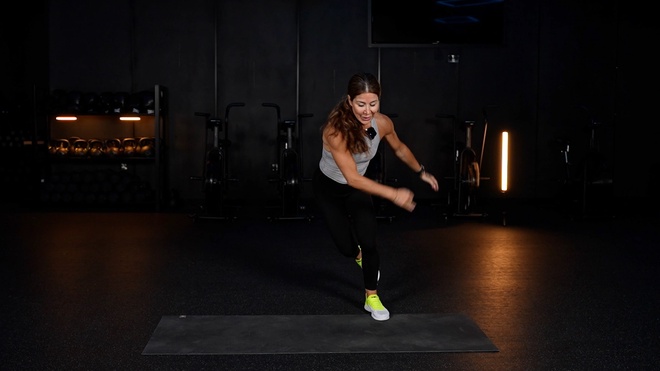

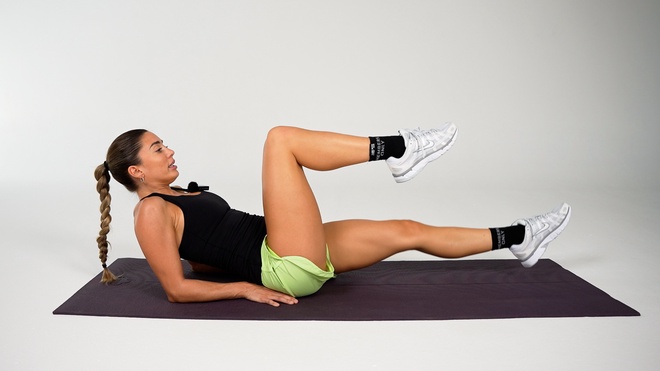
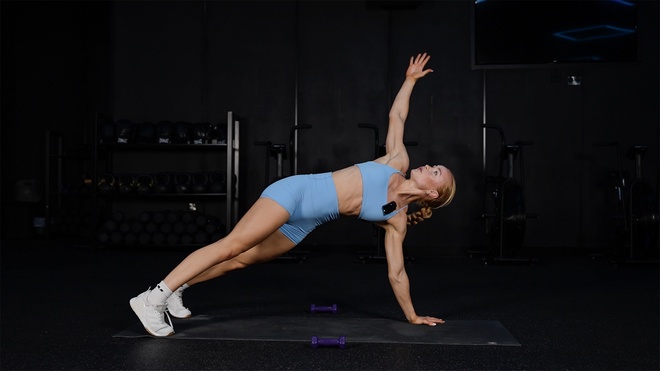
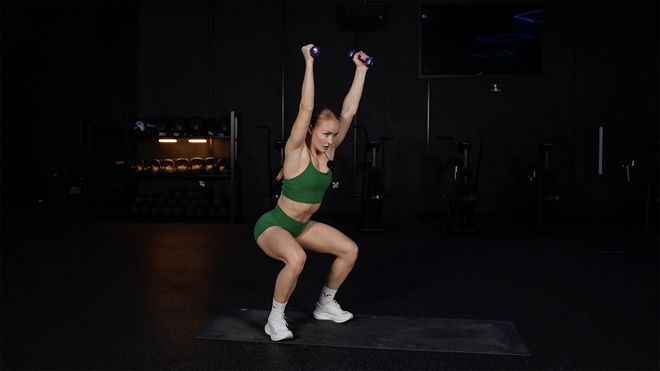
Join women building anti-rotation core strength with 4 certified trainers across 6 workouts
Frequently Asked Questions
Related Exercises
Plank
The foundation. Master a 45-second static plank before adding shoulder taps. The plank trains anti-extension. Shoulder taps add anti-rotation on top of it.
Dead Bug
Another anti-rotation exercise, but supine instead of prone. Dead bugs are the gentler entry point. If plank shoulder taps are too demanding, dead bugs build the same motor pattern from the floor.
Mountain Climbers
Same starting position, different movement. Mountain climbers emphasize hip flexion and cardio. Shoulder taps emphasize anti-rotation and control. Program them together for a complete plank-position training block.
Renegade Row
The loaded progression. A renegade row is a plank shoulder tap with dumbbells and a pulling motion. Once you can do 15 slow, controlled plank shoulder taps with zero hip movement, renegade rows are the next step.
Bird Dog
Quadruped anti-rotation exercise that adds a leg component. Bird dogs and plank shoulder taps target the same deep stabilizers from different positions. Pair them in a core stability circuit.
Get plank shoulder taps in a guided workout
Access 7 workouts featuring this exercise, plus personalized plans from Dr. Wellls.
Join women building anti-rotation core strength with 4 certified trainers across 6 workouts
Your membership funds independent women's health research