Plank Toe Taps: How-to, Benefits & Variations
Plank toe taps are a core and hip stability exercise: from a high plank, step one foot out to the side, tap the floor, return, alternate sides. Targets deep core and glutes.
Plank Toe Taps: How-to, Benefits & Variations
Here is what people get wrong about plank toe taps: they think it is a leg exercise with a plank underneath it.
It is the other way around. The plank is the point. The toe tap is the test.
When you step one foot out to the side from a high plank, your body immediately wants to shift its weight toward the moving leg, dip the hip on that side, and rotate through the torso. The entire job of your core in that moment is to say no to all three of those things at once. That simultaneous anti-shift, anti-dip, anti-rotation demand is what makes plank toe taps a genuinely different stimulus from a static plank hold — and a more demanding one.
Sophie Jones, who leads this exercise in the Body by Band series, puts it simply: keep your hips level and avoid letting your bum pike up toward the ceiling. Three words that contain an entire biomechanical truth. The second your hips move, your deep stabilizers have already lost the argument.
Only one workout in our library features this specific movement, which makes the coaching cues we have all the more worth studying closely. Sophie pulled ten distinct form cues across the session. They cover setup, breathing, weight distribution, foot control, and wrist care. All of that for what looks from the outside like simply tapping your foot to the side.
Body by Band: Session 3
Sophie Jones
How to Do Plank Toe Taps
Set up in a high plank with hands directly under your shoulders, arms straight, and feet hip-width apart. Sophie Jones: maintain a straight line from your head to your heels throughout the movement. Check your starting position before your first rep. If your lower back is arching or your hips are already piked, no amount of core bracing will fix it mid-set. Start with a neutral spine.
Press actively into the floor through your palms. Sophie: actively push away from the floor through your palms to engage your shoulders and upper back. This is not passive hand placement. It is active scapular depression and serratus engagement. Think about making the floor push back.
Engage your core before the foot moves. Sophie: engage your core deeply to prevent your lower back from arching as you step. Draw your navel toward your spine. Squeeze your glutes. Sophie again: squeeze your glutes to help keep your pelvis stable while the legs are moving. Both cues happen before the tap, not during it.
Step one foot out to the side. Tap the floor, then return it to center. Sophie: control the movement of your leg rather than letting it bounce or swing. The foot travels out and back under control. There is no momentum here. The movement is quiet. If your foot is landing with a thud, you are using momentum instead of muscular control.
Exhale as the foot taps out. Sophie: exhale as you tap your foot out to the side to help stabilize your midsection. The exhalation increases intra-abdominal pressure and reinforces your natural brace. Inhale as you return to center, then brace again for the next tap.
Alternate sides, keeping your weight centered throughout. Sophie: focus on keeping your weight centered so your body doesn't shift side to side. Your hips should look the same at the start of rep 10 as they did at the start of rep 1. If they have crept sideways or upward, slow down or take the knees-down modification.
Muscles Worked
Primary
Transversus abdominis and obliques (deep core)
These are the muscles doing the real work in plank toe taps. When one foot steps out, your center of gravity shifts toward that side. Your transversus abdominis and internal obliques fire simultaneously to resist the lateral shift and rotational pull. This anti-rotation demand is different from what a standard plank or crunch asks of these muscles. Resistance training research consistently shows core stability exercises reduce functional decline in perimenopausal women. Sophie's cue — focus on keeping your weight centered so your body doesn't shift side to side — is describing the exact demand placed on these deep muscles.
Gluteus medius and hip abductors
When one foot steps laterally, the gluteus medius on the stance leg works to prevent hip drop. This is the same mechanism that controls pelvic stability during walking, running, and single-leg balance. The gluteus medius is chronically underworked in people who sit for long periods. Sophie's cue — squeeze your glutes to help keep your pelvis stable — targets this muscle directly. A systematic review on balance interventions found that exercises combining core and hip stability produced greater benefits for perimenopausal women than either in isolation.
Rectus abdominis and multifidus
Your front and back core muscles work isometrically together to keep the spine neutral while the leg moves. The rectus prevents hip sag. The multifidus prevents lumbar rotation. They are rarely trained together in traditional ab exercises. The plank toe tap makes both work simultaneously. Sophie describes the result of their failure: if you see your hips dropping or piking, that is the signal these muscles have disengaged.
Secondary
Shoulders and rotator cuff
The planted arms bear your full upper-body weight throughout every tap. Your serratus anterior and lower trapezius stabilize the scapulae while your rotator cuff centers the shoulder joint under isometric load. Sophie: actively push away from the floor through your palms. This active press is what keeps the shoulder joint protected. Without it, you are just hanging on your ligaments.
Hip flexors
The hip flexors control the return phase of the toe tap. As your foot comes back to center, the hip flexors decelerate and guide the leg. Lengthened, controlled return prevents the foot from snapping back and disrupting your plank alignment. In women with shortened hip flexors from prolonged sitting, this eccentric load also serves as mild lengthening work.
Wrists and forearms
The weight shift during each tap loads the wrists unevenly, with more pressure landing on the planted side as the stepping foot leaves the floor. Sophie's modification — if your wrists feel strain, try performing the movement on your forearms — acknowledges this. Forearm variation keeps all core and hip benefits while eliminating wrist compressive load.
Why this matters in perimenopause
Plank toe taps address two systems that change during hormonal transition. The first is deep core stability. Estrogen influences connective tissue stiffness throughout the body, including the ligamentous support around the lumbar spine and pelvis. As estrogen declines, the deep stabilizers — transversus abdominis, pelvic floor — must compensate through muscular engagement. Exercises that train anti-rotation and anti-lateral-shift build this compensation capacity. The second is hip stability. A 2024 systematic review found balance and functional lower-body exercises specifically improved perimenopausal women's outcomes compared to exercises targeting only one of these systems. Plank toe taps train both in a single movement, without any equipment, from any floor.
Coach's Tips
"Keep your hips level and avoid letting your bum pike up toward the ceiling." Sophie Jones leads with this cue because it is the most common breakdown. Both failure modes — hips piked too high or sagging too low — signal that the core has disengaged. Level hips mean everything is working. Check your hip line every few reps. If you cannot feel whether your hips are level, set up next to a mirror once and see what it actually looks like.
Sophie Jones
"Actively push away from the floor through your palms to engage your shoulders and upper back." Sophie uses this cue before the first rep. Passive hand placement creates a dead shoulder joint. Active pressing engages the serratus anterior and keeps your scapulae from winging. You will feel the difference immediately — pressing activates a line of engagement from palm through shoulder into your upper back that makes the whole plank feel more solid.
Sophie Jones
"Squeeze your glutes to help keep your pelvis stable while the legs are moving." Most people think of plank toe taps as a core exercise and forget the glutes entirely. Sophie doesn't. The gluteus medius is the primary pelvis stabilizer during any lateral leg movement. Squeezing the glutes before the foot moves preloads the stability system before gravity has a chance to act on it.
Sophie Jones
"Exhale as you tap your foot out to the side to help stabilize your midsection." This is the breathing cue most people skip. But Sophie is right about the physiology. Exhalation creates a natural Valsalva-like intra-abdominal pressure increase that stiffens the core. Breathing randomly breaks this pressure cycle. Tie the exhale to the tap, inhale as you return, exhale as the next foot taps. Once it becomes automatic, your core will feel noticeably more braced.
Sophie Jones
"Engage your core deeply to prevent your lower back from arching as you step." The step-out phase is when lower backs arch. The hip flexor on the stepping side shortens as the foot moves away from center, which tugs the lumbar spine into extension if the core has not already braced. Sophie's cue is about timing: brace before the step, not during it. If your lower back arches even with a good brace, the modification is clear — step out less far until your core can handle the full range.
Sophie Jones
"If your wrists feel strain, try performing the movement on your forearms." Sophie names this explicitly. Forearm plank toe taps keep the exact same core and hip challenge while eliminating the wrist compressive load. Elbows go directly under shoulders, forearms flat on the floor. From there, the toe tap mechanics are identical. This is not a regression — the forearm position slightly lowers your center of gravity, which can actually make it harder to prevent the hip shift.
Sophie Jones
"Perform the plank on your knees and tap your knees out, or hold a static plank without the leg movement." The knee plank variation preserves the anti-rotation challenge at a reduced load. Keep a straight line from head to knees, same hip-level requirement applies. If even the knee version feels unstable, start with a static forearm plank hold and build toward the tap once your base plank is solid for 30 seconds without compensation.
Sophie Jones
Why This Matters for You
Two things happen to the core during hormonal transition that plank toe taps directly address.
The first is pelvic floor and deep core weakness. Estrogen decline affects connective tissue throughout the body, including the fascial support structures around the lumbar spine and pelvis. The deep stabilizers — transversus abdominis, multifidus, pelvic floor — must compensate through muscular engagement as passive support decreases. A systematic review found resistance and stability training mitigated menopausal symptoms including musculoskeletal complaints more effectively than no exercise. Plank toe taps train the anti-rotation and anti-lateral-shift patterns that directly support this compensation.
The second is hip stability. Balance performance declines during perimenopause. A 2024 network meta-analysis in the British Journal of Sports Medicine found that combined core-and-hip-stability exercises were among the most effective interventions for balance improvement in perimenopausal and early postmenopausal women. Plank toe taps require the gluteus medius to prevent hip drop on every single rep — the same demand that supports confident movement on stairs, uneven ground, and everything in between.
These are not fall-prevention exercises. They are the foundation of moving without thinking twice.
Variations & Modifications
Forearm Plank Toe Taps
low-mediumSame lateral toe tap performed from a forearm plank instead of high plank. Elbows directly under shoulders, forearms flat, wrists neutral. Eliminates all wrist compressive load. Sophie Jones names this explicitly: if your wrists feel strain, try performing the movement on your forearms. The lower center of gravity in forearm position can actually increase the anti-shift demand on your core. This is not a downgrade. For anyone with wrist pain, carpal tunnel, or recovering from a wrist injury, this is the primary variation.
Kneeling Plank Toe Taps
lowPlank held from the knees instead of toes, with lateral knee taps replacing lateral foot taps. Maintains the full anti-rotation pattern at roughly 40% reduced load. Keep a straight line from head to knees. The hip stability demand is the same — your gluteus medius still has to prevent the stance hip from dropping as the knee steps out. Use this version if a full plank cannot be held for at least 20 seconds, or when returning from core weakness after surgery or childbirth.
Banded Plank Toe Taps
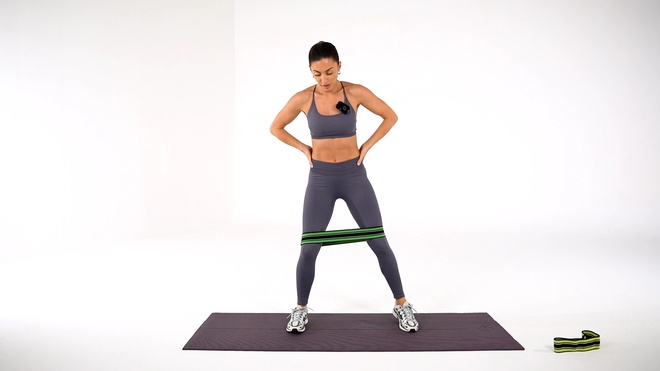
medium-highStandard plank toe taps with a light resistance band looped around both ankles or just above the knees. The band adds abduction resistance to the stepping foot, forcing the gluteus medius and hip abductors to work against external load throughout the tap. The return phase also becomes a controlled adduction against the band. This is the progression once standard toe taps feel too easy at 12 reps per side. Sophie references this variant in the merged modification cues for the exercise: place a resistance band around your ankles or just above your knees to increase the challenge for your glutes.
Benefits
Two planes of core stability in one movement
A standard plank trains anti-extension — preventing your hips from sagging. Plank toe taps layer anti-lateral-shift and anti-rotation on top of that. Three planes, one exercise, no equipment. This matters because daily life rarely challenges your core in one direction at a time. Carrying a grocery bag on one side, stepping off an uneven curb, reaching across your body for something — these all require your core to resist movement in multiple directions simultaneously. Plank toe taps train exactly that pattern.
Hip and pelvis stability without a single crunch
The gluteus medius — the side-glute muscle that prevents your hip from dropping during any single-leg activity — works hard during every toe tap. Most core exercises ignore it entirely. Plank toe taps force it into the same anti-drop fight it runs every time you walk up stairs, step over something, or carry a child on one hip. A 2024 meta-analysis of balance interventions in perimenopausal women found that combined core-and-hip-stability training produced measurably better functional outcomes than core training alone.
Shoulder loading without weights
Both planted arms bear your full upper body weight throughout every tap. When the opposite foot lifts, your single supporting arm handles asymmetric load across the shoulder joint. This trains the rotator cuff and serratus anterior under closed-chain conditions — the same conditions your shoulder faces when you push open a heavy door, catch yourself on a wall, or lower something off an overhead shelf. Resistance training research confirms that closed-chain shoulder exercises build shoulder resilience more effectively than isolated deltoid work.
Low impact, no joints loaded axially
The spine and joints bear no compressive load from external weight. There is no impact phase. No jumping, no heavy landing, no spinal loading under a barbell. The challenge is entirely neuromuscular — your nervous system coordinating three planes of stability at once. This makes plank toe taps one of the few genuinely demanding core exercises that is simultaneously appropriate during hormonal transition, after pelvic floor rehabilitation, and with knee or hip concerns that rule out impact training.
Common Mistakes to Avoid
Frequently Asked Questions
Related Exercises
This exercise helps with
Get plank toe taps in a guided workout
Access 1 workouts featuring this exercise, plus personalized plans from Dr. Wellls.
Your membership funds independent women's health research