Standing Roll Down: Form, Benefits & Pilates Variations
Standing roll down: tuck chin, peel spine down vertebra by vertebra, hang, restack from tailbone up. Also called pilates roll down. Releases spinal tension, improves posture.
Standing Roll Down: Form, Benefits & Pilates Variations
Spine health isn't something most people think about until it's already problematic. You notice the ache between your shoulder blades around 3pm. Or the way you have to grip the steering wheel with both hands to twist and look backward. Or standing up from the floor requires a moment — an actual moment where you steady yourself and breathe.
The standing roll down undoes the thing that causes most of this. Not with force. With articulation.
Here's the distinction Pilates trainers make that most fitness content skips: spinal articulation isn't the same as bending forward. Bending is hinging from the hips with a stiff back. Articulation is peeling the spine one vertebra at a time — thoracic, then lumbar, then releasing the head and neck last. The difference in muscle recruitment and fascial decompression between the two is considerable.
In the standing roll down (also called the pilates roll down), you start tall: feet hip-width, knees soft, shoulders back. You tuck the chin toward the chest and begin the descent. Not a dive, not a flop — a peel. Each vertebra follows the one above. The shoulders round forward. The mid-back curves. The lower back yields. You hang at the bottom as much as your hamstrings allow, breathing. Then you rebuild: tailbone leads, vertebra by vertebra, until your shoulders stack over your hips and your head floats to the top.
That rebuilding phase is where the real work lives. It teaches the intrinsic spinal stabilisers — the small multifidus muscles running between vertebrae — to fire in sequence, not in one coordinated clench. This sequencing matters in everyday life every time you lift something from the floor, tie a shoe, or stand up from a low chair.
With 29 workouts in our library featuring this move and 13 different certified trainers cueing it, we have more real coaching data on the standing roll down than almost any other flexibility exercise. The most consistent cue across all of them: your head is the last thing down and the last thing up. Not first. Last.
Full Workout
Sophie Jones
How to Do Standing Roll Down
Stand with feet hip-width apart, knees soft. Arms hang at your sides. Shoulders relaxed and back.
Tuck your chin toward your chest. Let the neck lengthen.
Allow the shoulders to round forward, then begin peeling the spine downward one vertebra at a time.
Exhale slowly as you descend. Keep the knees soft throughout.
Hang at the bottom with arms dangling and head completely heavy. Take one or two full breaths.
Exhale, then begin restacking from the tailbone. The sacrum tilts, the lumbar lifts, the thoracic follows.
Roll up vertebra by vertebra. The shoulders stack last, then the neck lengthens, and the head rises to the top.
Muscles Worked
Primary
Erector spinae (spinal extensors)
The primary muscles running alongside the spine that lengthen under control on the way down and fire in sequence to rebuild the upright posture from the tailbone up. The roll down teaches these muscles to activate vertebra by vertebra rather than contracting as one rigid block.
Multifidus (intersegmental stabilisers)
The small, deep muscles between individual vertebrae that control the sequential movement. Most people have never consciously activated these. The rebuilding phase of the standing roll down — tailbone leads, vertebra by vertebra — is where multifidus sequencing training actually happens.
Hamstrings
Receive a sustained stretch at the bottom of the roll down. The soft-knee modification reduces hamstring demand to keep the focus on spinal articulation. As hamstring flexibility develops, the knees can gradually straighten over weeks.
Secondary
Rhomboids and neck extensors
Release and lengthen during the descent as the shoulders round forward and the head hangs. The bottom position gives these chronically tight muscles — especially in desk workers — permission to let go.
Core (transverse abdominis)
Stabilises the lumbar spine during the rebuilding phase. Without core engagement, the roll-up becomes a passive sway rather than a controlled restack.
Shoulder girdle muscles
The shoulders progressively round forward during descent, stretching the pectorals and anterior deltoids. During the restack, the shoulder blades draw back to their neutral position.
Coach's Tips
Drop the chin first. Not the shoulders, not the chest — the chin. Then let the shoulders round forward, and only then start peeling vertebra by vertebra. If you lead with your shoulders, the mid-back compresses rather than articulates.
Sophie Jones
Imagine you're peeling your upper body off a wall — one bone at a time. That mental image actually changes what happens in your back. You'll feel individual segments let go instead of everything collapsing at once.
Bonnie Lyall
Exhale on the way down, inhale at the bottom, exhale on the roll back up. The breath isn't optional — it cues the deep core to stabilise each vertebra as it moves. Holding your breath creates tension that defeats the whole purpose.
Multiple trainers
Your head and chin are the last things to lift on the way up. Full stop. Lots of people yank the head up first. That compresses the cervical spine and undoes the decompression work you just did.
Mish Naidoo
Keep your knees soft — a slight bend — throughout. Locked knees create posterior chain tension that restricts how much the lower spine can articulate. Soft knees let the lumbar curve do its job.
Natalia Gunnlaugs
If your hamstrings are tight, keep a generous knee bend and just focus on the spinal articulation. The goal isn't to touch the floor. The goal is to feel each segment of the spine move independently. You get the full benefit with bent knees.
Multiple trainers
Why This Matters for You
During perimenopause, the spine gets caught in two competing forces. Falling oestrogen reduces the water content of intervertebral discs, making them stiffer and less shock-absorbing. At the same time, cortisol from elevated stress loads keeps the erector spinae muscles in a low-grade, chronic contraction. You feel this as that particular mid-back heaviness that builds through the afternoon and doesn't fully release, even after a night's sleep.
The standing roll down addresses both directly. The articulated descent creates gentle traction through each segment of the spine, momentarily decompressing facet joints and hydrating disc tissue through movement (discs have no direct blood supply — they absorb nutrients through movement, like a sponge). The hang at the bottom gives the erector spinae, rhomboids, and neck extensors permission to release, which most of them haven't had since morning.
There's also a parasympathetic element here that's relevant as hormones shift. Slow, controlled forward flexion with breath-coordinated movement activates the vagal pathways — the nerve branches that regulate the fight-or-flight response. A meta-analysis of 927 perimenopausal women found that mind-body movement significantly reduced psychological symptoms including anxiety (SMD -0.32; 95% CI -0.47 to -0.17) [id:7148]. That's not a small effect for a 60-second movement you can do anywhere.
Bone density matters here too. While the standing roll down isn't a loading exercise per se, it's a critical component of the movement patterns that keep the lumbar spine functional for the loading exercises (deadlifts, squats, carries) that directly build bone. Research confirms that Pilates-based exercise significantly reduces chronic low back pain (SMD -1.31, p<0.00001) [id:15366] — and when your back doesn't hurt, you actually do the exercises that build bone.
Variations & Modifications
Pilates Roll Down (Classic)
lowThe foundational form. Arms hang loose, knees soft, full spinal sequencing. This is the pilates roll down as taught in classical mat Pilates. Identical to the standing version — Pilates instructors use both names interchangeably.
Hands Clasped Behind Neck
low-mediumInterlace the fingers at the base of the skull. The gentle weight of the hands deepens the cervical stretch at the bottom. Particularly effective for releasing tension in the suboccipital muscles — the small muscles at the skull-neck junction that lock up during desk work and driving.
Spinal Roll Down with Transition to Forward Fold
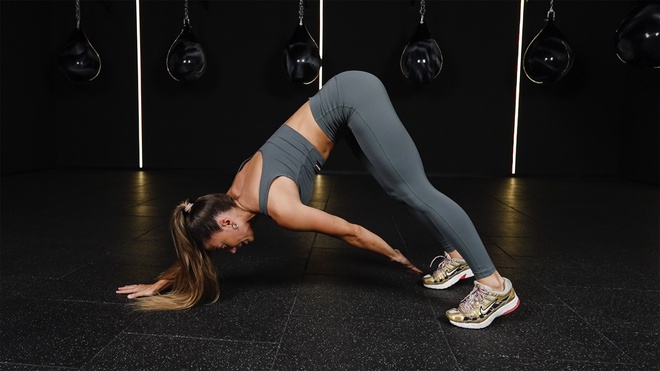
lowAt the bottom of the roll, walk your hands forward to a plank or downward dog. Converts a spinal release into a full-body flow. Requires more hamstring flexibility and more floor space — good for a morning movement sequence.
Roll Down with Hip Pulses
low-mediumAt the bottom of the fold, add small pulsing movements with the neck toward the legs. Each pulse deepens the hamstring and spinal stretch. Keep the movements tiny — this isn't a bounce. It's a gentle, rhythmic release.
Bent-Knee Roll Down
lowThe modification for tight hamstrings, disc sensitivity, or anyone learning the movement. Bent knees remove posterior chain restriction so the spine can articulate fully without compensating. Start here and gradually straighten over weeks.
Benefits
The antidote to everything a desk does to your spine
Teaches the spine to move the way it was built to move
A 60-second nervous system reset
The gateway to every other spinal exercise
Common Mistakes to Avoid
Leading with the shoulders instead of the chin
The chin tucks first, then the shoulders round, then the thoracic spine follows. If you dive from the shoulders, the upper back compresses rather than articulates. The chin-first sequence creates the wave.
Lifting the head first on the way up
The head and chin come up last. Always. The rebuilding sequence starts from the tailbone, moves through the lumbar, through the thoracic, then the shoulders stack, and only then does the neck straighten and the head float to the top. Lifting the head first yanks the cervical spine and skips the stabilisation work.
Holding the breath or breathing shallowly
The breath is structural here, not optional. Exhale signals the deep core to stabilise each vertebra as it moves. Without the exhale, you lose the internal support and the movement collapses into passive hanging instead of active articulation.
Locking the knees
Locked knees pull the hamstrings taut before you begin, which limits how far the lumbar spine can participate in the movement. Keep a soft bend throughout. The goal is spinal articulation, not hamstring length.
Workouts Featuring This Exercise
Frequently Asked Questions
This exercise helps with
Get standing roll down in a guided workout
Access 10 workouts featuring this exercise, plus personalized plans from Dr. Wellls.
Your membership funds independent women's health research