Standing Spinal Wave: How-to, Benefits & Variations
Standing spinal waves roll the spine one vertebra at a time. Restores segmental articulation lost from sitting. Curl down slowly, then stack up vertebra by vertebra.
Standing Spinal Wave: How-to, Benefits & Variations
Try this. Stand up and roll your spine from your tailbone to the top of your head, one vertebra at a time, like a wave moving up a chain. If you can feel each segment articulate independently, your spinal mobility is intact. If the whole thing moves as one stiff block, this exercise is for you.
Standing spinal waves are a segmental mobility drill. You start from a slight forward fold and slowly stack each vertebra on top of the next, peeling your spine upward like tape lifting off a surface. Then you reverse it, curling down from the head, softening through the upper back, middle back, and finally the lower back.
The beauty of this exercise is its diagnostic quality. Wherever the wave stalls or jumps, that is where you have stiffness. Most women find a dead spot between their shoulder blades, the exact region that locks up from hours of screen work. The exercise itself is the treatment. Repeated waves gradually restore the segmental motion that sitting steals.
Mobility 1
Yasmin Masri
How to Do Standing Spinal Waves
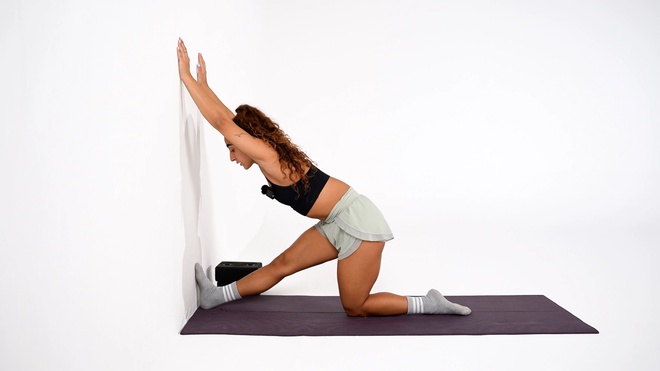
Start in the initial position for standing spinal wave. Breathe steadily and find your alignment before moving deeper.
Move into the stretch slowly, following your breath. Never force past discomfort.
Hold the position for 20-30 seconds, breathing deeply into the stretch.
Release slowly and repeat on the other side if applicable.
Yasmin Masri adds: "Chin down. I tuck my chin down, rounding my torso, and then I open from my mid-back, chin up."
Muscles Worked
Primary
Secondary
Why this matters in perimenopause
declining estrogen reduces connective tissue elasticity, making stretching essential. The standing spinal wave directly supports this by targeting key muscle groups.
Coach's Tips
"As you exhale, bring your elbows down all the way towards your knees, relaxing your head and neck at the bottom." - Lianna Brice
Lianna Brice
"Take your feet just a little bit wider than your hips, and make sure your toes are facing forward." - Lianna Brice
Lianna Brice
"Chin down. I tuck my chin down, rounding my torso, and then I open from my mid-back, chin up." - Yasmin Masri
Yasmin Masri
"The further away the arms are from your center of gravity, the harder it gets." - Yasmin Masri
Yasmin Masri
Why This Matters for You
declining estrogen reduces connective tissue elasticity, making stretching essential. The standing spinal wave maintains mobility and reduces stiffness during a time when the body needs it most. Research supports regular stretching for women during the menopausal transition.
Variations & Modifications
Standing Spinal Waves (Straight Knees)
mediumStanding Spinal Wave / Good Morning
mediumStanding Spinal Waves (Bent Knees)
lowBenefits
Improves flexibility
Regular standing spinal wave practice restores range of motion that desk work and daily habits gradually steal.
Supports your body through hormonal changes
declining estrogen reduces connective tissue elasticity, making stretching essential. The standing spinal wave directly addresses this.
Requires minimal equipment
No equipment needed. You can do the standing spinal wave at home, in a hotel room, or between meetings.
Common Mistakes to Avoid
Forcing the stretch past pain
Discomfort is acceptable. Sharp or stabbing pain is not. Back off until you feel a pull, not a stab.
Holding your breath during the hold
Breathe steadily and deeply. The stretch actually deepens when you exhale and relax into it.
Workouts Featuring This Exercise
Join women building strength and confidence with certified trainers
Frequently Asked Questions
This exercise helps with
Get standing spinal waves in a guided workout
Access 5 workouts featuring this exercise, plus personalized plans from Dr. Wellls.
Join women building strength and confidence with certified trainers
Your membership funds independent women's health research