Supine Twist: How-to, Benefits & Variations
The supine twist stretches spine, obliques, hips, and chest by dropping bent knees to one side while lying down. Hold 30-90 seconds per side. Relieves lower back tension, improves sleep.
Supine Twist: How-to, Benefits & Variations
When was the last time you twisted your torso on purpose? Not reaching for a seatbelt. Not turning to check on a kid in the back seat. When did you last deliberately rotate your spine through its full range, slowly, with your breath, because that range matters and you are losing it?
Most people can't answer that. The spine rotates. That's one of its primary jobs. But modern life has made spinal rotation an accident rather than a practice. You sit facing forward. You walk facing forward. You sleep curled in the same direction every night. The muscles along your spine, the obliques wrapping your midsection, the deep rotators connecting one vertebra to the next - they get shorter, stiffer, and more resistant to movement they no longer perform.
The supine twist is the simplest correction available. Lie on your back. Drop your knees to one side. Look the other way. Breathe. That's it. No flexibility prerequisite. No strength requirement. No equipment beyond a floor.
But simple is not the same as insignificant. The supine spinal twist decompresses the lower back by creating gentle traction between the vertebrae. It stretches the chest and shoulders that spending hours at a desk has concreted shut. It stimulates the parasympathetic nervous system in a way that yoga researchers have measured and documented. And it does all of this while you lie down.
I teach this pose in six different workouts across our library. Night stretch sequences. Vinyasa flows. Yoga for back relief. Barre cool-downs. Every trainer reaches for this twist at the end because it does what ten minutes of foam rolling tries to do, and it does it in sixty seconds flat. Mish Naidoo, Petra Kapiciakova, Linda Chambers, Jessica Casalegno, Nuni Soriano, Lianna Brice - six different trainers, six different styles, same instinct. The supine twist earns its place.
Morning Yoga Flow: Session 6
Mish Naidoo
How to Do Supine Twist
Lie on your back with both knees bent, feet flat on the floor, arms relaxed by your sides. Take a breath here. Ground your shoulder blades into the mat. This is your starting position, and grounding the shoulders is the single most important setup cue. Mish Naidoo says it in every session: let the shoulders touch the floor, and then breathe into it.
Open your arms out to the sides at shoulder height, forming a T-shape. Opening your arms into a T stabilizes your upper body and gives your chest room to open during the twist. Every trainer in our library cues this the same way. Petra Kapiciakova says: open our arms to the sides. Jessica Casalegno cues: opening up your arms into a T. The T-shape anchors you.
On an exhale, slowly drop both knees to the left side. Go as far as your shoulders allow while both stay flat on the mat. Petra Kapiciakova makes this the non-negotiable rule: go only as low as your shoulders are still on the mat. If the opposite shoulder lifts, you've gone too far. Pull back until both blades touch.
Turn your head to the right, looking away from your knees. This completes the twist through the full length of the spine, from lumbar through thoracic into cervical. Linda Chambers cues it simply: drop the knees over to one side, turn the head in the opposite direction. The neck rotation is where the stretch reaches the upper back and shoulders.
Hold for 30 to 90 seconds, breathing slowly. Inhale through the nose for four counts. Exhale for four counts. With every exhale, let the knees sink a fraction closer to the floor. Don't push. Petra Kapiciakova teaches a four-count breath cycle here specifically. The exhale is where the release happens. Mish Naidoo adds: with every exhale, softening into the posture.
Inhale to bring the knees back to center. Pause. Then exhale and drop the knees to the right side, turning the head to the left. Hold equally on both sides. Nuni Soriano cues the transition: hug your knees into your chest, then take the other side. Always do both sides. One side will feel tighter. That's the side that needs the extra breath.
Muscles Worked
Primary
Erector spinae and spinal rotators (deep back muscles)
The supine twist takes the spine through axial rotation. The multifidus, rotatores, and erector spinae along each side of the spine alternately stretch and release as the knees fall to one side. These deep spinal muscles are the first to stiffen from prolonged sitting and the last to get addressed by conventional stretching. The supine spinal twist accesses them directly because gravity, not muscle effort, creates the rotation. A 2020 randomized trial found yoga-based spinal rotation significantly improved trunk flexibility and reduced chronic low back pain scores.
External and internal obliques
The obliques wrap the midsection diagonally. When your knees drop left, the right external oblique and left internal oblique lengthen. When your knees drop right, the opposite pair stretches. This is rotational stretching at its most basic. The obliques handle every twisting, bending, and rotating movement your torso makes. Keeping them supple directly affects your ability to check blind spots, twist to grab things, and move through daily life without compensation patterns.
Gluteus medius and piriformis (outer hip and deep hip rotators)
As the knees drop to one side, the top hip's gluteus medius and piriformis receive a stretch. This is the same area that gets tight from sitting and often refers pain down the leg or into the sacroiliac joint. Mish Naidoo specifically references releasing tightness in the outer glute, which releases the pressure to the lower back. That's the connection: tight glutes pull on the lower back, and the supine twist addresses both simultaneously.
Secondary
Pectoralis major and anterior deltoids (chest and front of shoulders)
With arms in the T-position, the chest and front shoulders are held in an open, stretched position while the lower body rotates. This combination stretches the pectorals passively, countering the forward-rounded posture of desk work. The twist adds a diagonal pull across the chest that a standard chest stretch doesn't reach.
Quadratus lumborum (QL) and lateral trunk muscles
The QL runs from the pelvis to the lowest rib on each side. It's one of the primary muscles responsible for that deep, one-sided lower back ache after sitting too long. The supine twist lengthens the QL on the side opposite the knees, providing a lateral decompression that complements the rotational stretch.
Coach's Tips
Open your arms into a T, and with your exhale, drop your knees to one side. The exhale is the timing. Not inhale, not holding your breath. Exhale, and the knees go. This is how Petra Kapiciakova teaches it in every back relief session.
Petra Kapiciakova
Bring your right knee all the way across towards the left side. Try to keep both shoulders nice and flat. Those two instructions live in permanent tension with each other. The knees want to go far. The shoulders want to lift. Find the point where both stay honest.
Jessica Casalegno
Knees stay together. They don't separate at all. If the knees drift apart, the twist dissipates through the hips instead of targeting the spine. Stack them, hold them, rotate as one unit.
Nuni Soriano
Go only as low as your shoulders are still on the mat. I say this twice because it's the rule that protects your lower back. The moment the opposite shoulder lifts, the twist has moved from your thoracic spine into your lumbar spine, and that's where injuries happen.
Petra Kapiciakova
If it feels comfortable, you can also place the pillow between your legs, so you can completely relax your back. The pillow removes the last few degrees of range that your body is bracing against. Sometimes less range means deeper release.
Petra Kapiciakova
You can straighten this foot and take it across, working into the IT band. That's the single-knee version. If you've got one hip tighter than the other, or if sciatica is a factor, this isolates the stretch where you need it most.
Mish Naidoo
Inhale for four counts through your nose, and exhale for four counts. The breath is the mechanism, not the movement. The movement creates the position. The breath creates the release. Four counts in, four counts out, and the spine decompresses one exhale at a time.
Petra Kapiciakova
Scanning your body and noticing, how does your body feel right now in this moment? Take a moment to notice how you feel emotionally today. This isn't filler instruction. The supine twist is one of the few poses where you have nothing to do but listen.
Mish Naidoo
Why This Matters for You
Your nervous system is running hotter than it used to. That's not a metaphor. As estrogen fluctuates during perimenopause, the autonomic nervous system loses some of its regulation. Cortisol stays elevated longer. Sleep architecture fragments. The body holds tension it used to release automatically.
The supine twist addresses this through a mechanism that yoga researchers have been documenting for two decades. Slow, breath-linked spinal rotation activates the parasympathetic nervous system. An umbrella review and meta-analysis found yoga significantly improved vasomotor symptoms, psychological symptoms, and quality of life in peri- and postmenopausal women. A separate meta-analysis of randomized controlled trials found yoga-based interventions significantly reduce anxiety symptoms. These are not small-sample pilot studies. These are aggregate findings across dozens of trials.
For sleep specifically: a randomized controlled trial found yoga improved sleep quality across different menopause statuses, and a systematic review of yoga nidra confirmed that restorative practices improve both sleep onset and sleep maintenance. The supine twist done before bed, held for 60 to 90 seconds per side with slow breathing, directly engages the nervous system downshift that makes sleep possible. Multiple Wellls trainers program this twist into night stretch and restore-and-reset sequences for exactly this reason.
For the lower back: the disc spaces between vertebrae lose hydration as estrogen declines, which contributes to stiffness and compression. Gentle spinal rotation improves nutrient delivery to the intervertebral discs through a pumping mechanism. The supine twist, because it's gravity-assisted and passive, provides this benefit without loading the spine.
Petra Kapiciakova makes an observation during the twist that lands differently once you understand the connection: massaging your internal organs, and even helping your digestion. She's referencing the visceral mobilization that happens during trunk rotation. Digestion and gut motility are common perimenopause complaints. The twist addresses them through the same parasympathetic pathway.
Variations & Modifications
Supported Supine Twist (with pillow)
lowPlace a pillow or yoga block between or under the knees to reduce the range of motion and support the lower back. This version, taught by Petra Kapiciakova in Yoga for Back Relief 1, is the entry point for anyone with lower back sensitivity or very tight hips. The prop takes the strain out of the stretch so you can actually relax into it.
Supine Twist with Eagle Legs
mediumWrap one thigh over the other before dropping the knees to one side. Nuni Soriano teaches this in the Vinyasa Flow as a deeper variation. The eagle wrap intensifies the stretch through the outer hips, IT band, and deep glute rotators. Only attempt this after the basic version feels comfortable.
Single Knee Supine Twist
low-mediumExtend one leg straight along the mat and only bring the opposite knee across the body. Mish Naidoo teaches this version: extend your right leg long, and then guide your left leg across to a ninety-degree bend. This isolates the stretch to one hip and the IT band, and it's often prescribed for sciatica-related tightness.
Both Knees Together Supine Twist
lowKeep both knees stacked and bent at ninety degrees, dropping them together to one side. Nuni Soriano cues this precisely: knees stay together, they don't separate at all. This version focuses the rotation through the lumbar and lower thoracic spine rather than the hips.
Hand-Guided Supine Twist
low-mediumUse the opposite hand to gently press the top knee closer to the floor. The canonical merged cues include: use your hand to gently guide the knee closer to the floor, but do not force the movement. Mish Naidoo teaches this: our right hand can help you push the thigh down. The hand adds light pressure, not force.
Benefits
Common Mistakes to Avoid
Shoulders lifting off the mat
This is the mistake that voids the entire exercise. If your opposite shoulder lifts as the knees drop, you've gone too far. Every trainer in our library says the same thing: Petra says go only as low as your shoulders are still on the mat. Mish says making sure the right shoulder is down to the mat. Linda says try and keep shoulders down on the floor as much as possible. Pull the knees back until both shoulders are grounded, even if that means the knees hover six inches above the floor.
Forcing the knees to the floor
The floor is not the goal. The twist is the goal. Mish Naidoo cues: as soon as the knee lifts up, you're going too much. If your knees don't touch, place a pillow underneath them. Petra Kapiciakova teaches the same thing: if it feels comfortable, you can also place the pillow between your legs, so you can completely relax your back. Forcing depth creates muscle guarding, which is the opposite of release.
Holding the breath
The supine twist only works if you breathe through it. The exhale is what allows the connective tissue to release. Petra teaches a specific four-count inhale, four-count exhale pattern. Mish cues slow down every inhale and the exhales. If you catch yourself holding your breath, you're working too hard. Back off and breathe first.
Rushing the transition between sides
Mish Naidoo cues: move slowly and mindfully between sides to protect your lower back. Whipping the knees from left to right with momentum can strain the very muscles the twist is trying to release. Hug the knees to center, pause, then lower to the other side with control.
Workouts Featuring This Exercise
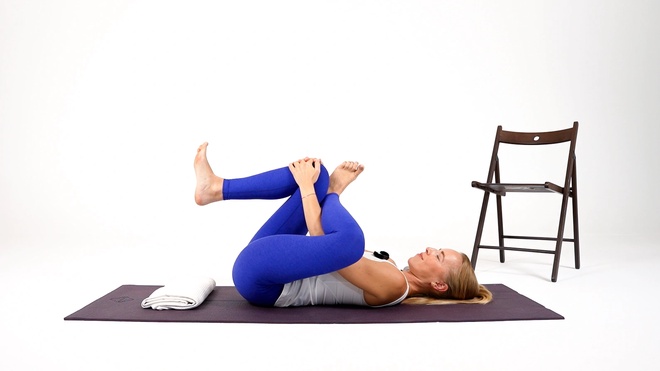
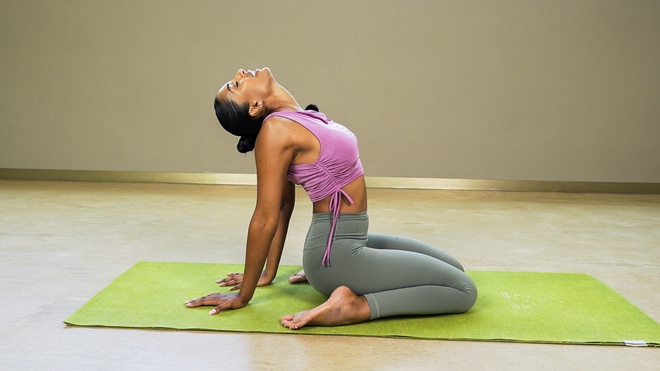
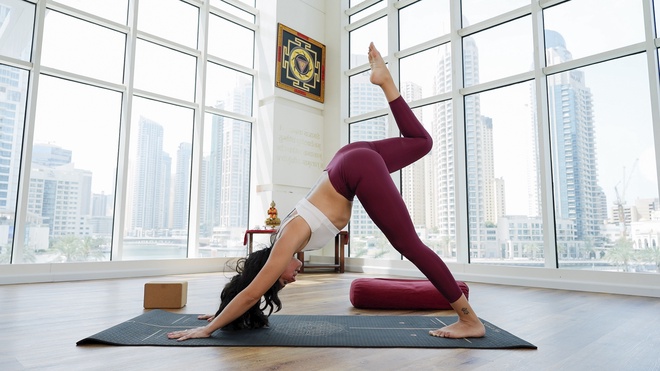
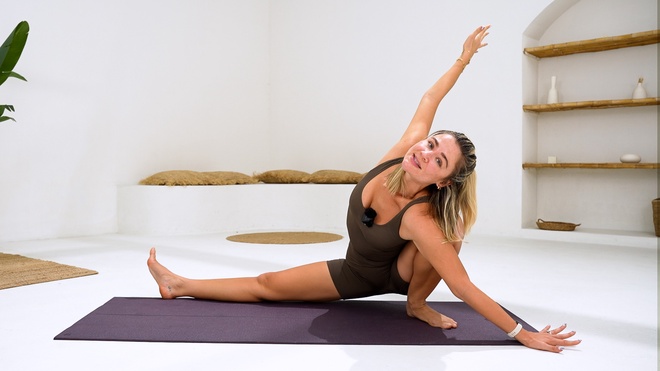
Join women decompressing their spines, releasing hip tension, and improving sleep with 6 certified trainers
Frequently Asked Questions
Related Exercises
Thread the Needle
Adds spinal rotation from a different position. Thread the needle targets the thoracic spine from all fours while the supine twist targets it lying down. Together they cover rotational mobility from two angles.
Cat-Cow Stretch
Mobilizes the spine through flexion and extension. Cat-cow warms up the sagittal plane while the supine twist addresses the transverse plane. Paired, they prepare the spine in two of three movement planes.
Knees to Chest
Often sequenced directly before the supine twist in our workout library. Knees to chest compresses the lower back before the twist decompresses it through rotation.
Pigeon Pose
Targets the deep hip rotators (piriformis, gluteus medius) from a different position. If the supine twist reveals hip tightness, pigeon pose addresses it more intensely.
Supported Fish Pose
The restorative counterpart. Supported fish opens the chest and thoracic spine through extension while the supine twist opens them through rotation. Both are floor-based and parasympathetic.
This exercise helps with
Get supine twist in a guided workout
Access 6 workouts featuring this exercise, plus personalized plans from Dr. Wellls.
Join women decompressing their spines, releasing hip tension, and improving sleep with 6 certified trainers
Your membership funds independent women's health research