Plank Variation: How-to, Benefits & Variations
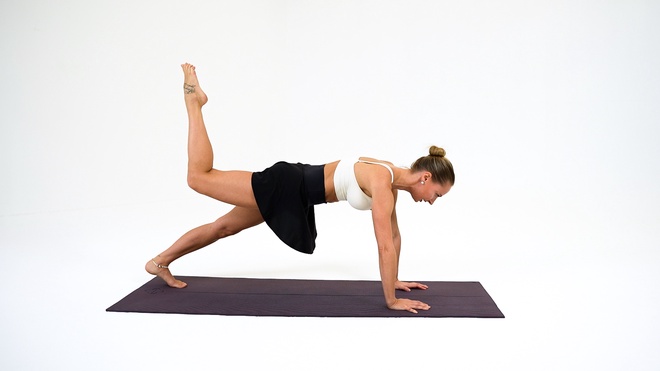
Plank variations target different core demands by changing arm position, adding movement, or shifting load. Rotate between forearm, shoulder-tap, and leg-lift planks for complete core training.
Plank Variation: How-to, Benefits & Variations
There is no single best plank. There is the plank your body needs right now. Maybe it is a forearm plank to build baseline endurance. Maybe it is a shoulder-tap plank to challenge rotation. Maybe it is a plank with leg lifts to fire your glutes. Plank variations exist because your core has dozens of jobs, and one position only trains a few of them. Rotate through variations and you cover the gaps.
Pilates Burn 1
Lianna Brice
How to Do Plank Variation: How-to, Benefits & Variations
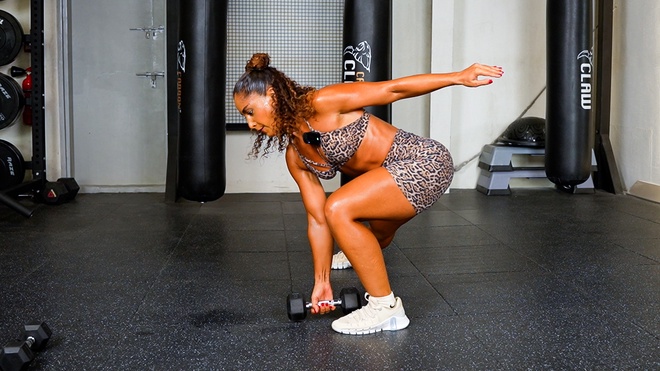
Set up in the starting position for plank variation. Feet hip-width apart (or as the exercise requires). Engage your core before initiating any movement.
Begin the movement with control. Bonnie Lyall cues: "Cross the right knee to the left elbow, left knee to the right elbow, push back into downward dog."
Complete the full range of motion. "If you're on your knees, I don't wanna see this [hips back]... need to be forward over those hands"
Return to the starting position with control. Stabilizing your lower back every time.
Linda Chambers adds: "From our plank position, we're going to pull back and pulse once, twice. Inhale, shift forwards."
Muscles Worked
Primary
Secondary
Why this matters in perimenopause
resistance training preserves muscle mass and bone density during perimenopause. The plank variation directly supports this by targeting key muscle groups.
Coach's Tips
"Cross the right knee to the left elbow, left knee to the right elbow, push back into downward dog." - Bonnie Lyall
Bonnie Lyall
"If you're on your knees, I don't wanna see this [hips back]... need to be forward over those hands" - Sophie Jones
Sophie Jones
"From our plank position, we're going to pull back and pulse once, twice. Inhale, shift forwards." - Linda Chambers
Linda Chambers
"Stabilizing your lower back every time." - Anastasia Zavistovskaya
Anastasia Zavistovskaya
"If you're starting to struggle on your taps, then you can just hold this position here." - Sophie Jones
Sophie Jones
"Exhaling as we lift, inhaling as we come forward into that plank" - Linda Chambers
Linda Chambers
Why This Matters for You
resistance training preserves muscle mass and bone density during perimenopause. The plank variation loads bones and builds lean muscle during a time when the body needs it most. Research supports resistance training for women during the menopausal transition.
Variations & Modifications
Plank Ups / Commandos
highPlank to Three-Legged Dog Knee Tucks
mediumLow Plank Hip Dips
highPlank to Down Dog Ankle Tap
mediumPlank Walkouts (Round 1)
mediumPlank Walks (Round 1)
mediumBenefits
Builds strength
The plank variation targets a key muscle group, making it efficient for building functional strength that transfers to daily activities.
Supports your body through hormonal changes
resistance training preserves muscle mass and bone density during perimenopause. The plank variation directly addresses this.
Requires minimal equipment
No equipment needed. You can do the plank variation at home, in a hotel room, or between meetings.
Common Mistakes to Avoid
Using momentum instead of muscle
Slow down. If you can't complete the plank variation with a two-second pause at the hardest point, the weight is too heavy or you're moving too fast.
Holding your breath
Exhale during the effort phase, inhale during the return. Holding your breath spikes blood pressure and reduces core stability.
Common form breakdown
Anastasia Zavistovskaya warns: "Stabilizing your lower back every time."
Workouts Featuring This Exercise
Join women building strength and confidence with certified trainers
Frequently Asked Questions
Related Exercises
This exercise helps with
Get null in a guided workout
Access 5 workouts featuring this exercise, plus personalized plans from Dr. Wellls.
Join women building strength and confidence with certified trainers
Your membership funds independent women's health research