How to know if you're in perimenopause: track cycle changes, new anxiety or insomnia, brain fog, and 30+ other symptoms for 2-3 months. Blood tests alone are unreliable.
34 Perimenopause Symptoms: The Full List Nobody Gave You
Over 30 symptoms linked to perimenopause
“What was your very first sign of perimenopause?”


Dr. A. Rybakova, Dr. A. Rybakov · Lifestyle Medicine
For informational purposes only. Not a substitute for professional medical advice.
It started with the 3am wakeups. Not the gentle kind where you drift back off in ten minutes. The bolt-upright, heart-hammering, staring-at-the-ceiling-for-two-hours kind. Then came the fog. Words you have used a thousand times just vanishing mid-sentence. Your coworkers started finishing your thoughts for you. Then the rage. The disproportionate, furniture-kicking fury over a misplaced car key. Your husband asked if you were okay. Your mother said you seemed "off." Your doctor ran a thyroid panel, told you everything looked normal, and handed you a prescription for an SSRI. Nobody mentioned perimenopause. Not once. And here is the thing that makes me genuinely angry on your behalf: you are not losing your mind. Your body is doing exactly what it is supposed to do. It is just that nobody taught you what that looks like, and the medical system was never designed to catch it. There are 34 documented symptoms of perimenopause. Thirty-four. Most women can name three. Most doctors test for zero.
Key takeaways
- How to know if you're in perimenopause: track cycle changes, new anxiety or insomnia, brain fog, and 30+ other symptoms for 2-3 months.
- Blood tests alone are unreliable.
- Progesterone decline precedes estrogen decline, causing anxiety, insomnia, and irritability via reduced GABA-A receptor activation
- Estrogen fluctuation (not just decline) characterizes early perimenopause, creating alternating symptoms of excess and deficiency
The Biology of Perimenopause: What Is Actually Happening Inside Your Body
Three years. That is how long the average woman spends searching for answers before someone connects her symptoms to perimenopause. Three years of unexplained anxiety spirals, of standing in the frozen foods aisle trying to remember what she came for, of waking at 3am with her heart pounding and no idea why. Three years of being told her thyroid is fine, her bloodwork is normal, maybe she should try yoga. I have spent months reading the research, and I keep coming back to the same infuriating conclusion: this is not a knowledge problem. The science has been clear for decades. Progesterone drops first. Estrogen goes haywire. The brain, the heart, the gut, the joints, the skin, the mood, the sleep, the cognition, the metabolism all respond to these hormonal earthquakes in ways that are well-documented, well-understood, and almost never explained to the women actually living through them. So here is what I want to do differently. I want to give you the biology. Not the sanitized, textbook version. The version that explains why last Tuesday you cried at a dog food commercial and then screamed at your partner for breathing too loudly. The version that explains the electric shock feeling in your fingers, and the word that vanished from your vocabulary mid-presentation, and the joint pain that appeared out of nowhere at 43. All of it has a mechanism. All of it has a name. And none of it means you are falling apart. Perimenopause symptoms affect the majority of women, yet most will experience them for years without receiving a correct explanation for what is happening.
The progesterone cliff that nobody mentions
Here is the part that genuinely surprised me when I dug into the endocrinology. Everyone talks about estrogen decline in menopause. That is the headline symptom. The hot flashes, the vaginal dryness, the bone density loss. Those are estrogen stories. But perimenopause does not start with estrogen. It starts with progesterone. And the timing matters enormously. Dr. Jerilynn Prior at the University of British Columbia's Centre for Menstrual Cycle and Ovulation Research has been publishing on this for twenty years. Her work shows that anovulatory cycles (cycles where you bleed but do not actually release an egg) begin increasing in your late 30s. No ovulation means no corpus luteum. No corpus luteum means no progesterone surge in the second half of your cycle. This is why the earliest perimenopause symptoms are not hot flashes. They are anxiety, insomnia, and irritability. Progesterone is your nervous system's natural sedative. It converts to allopregnanolone, which binds to GABA-A receptors in your brain, the same receptors targeted by benzodiazepines and alcohol. When progesterone drops, GABA activity drops, and your brain loses its built-in calming mechanism. You lie awake at night not because something is wrong with your sleep hygiene. You lie awake because the neurosteroid that used to put you to sleep is declining. This also explains why some women in early perimenopause feel like they are developing an anxiety disorder out of nowhere. They are not. Their GABA system just lost its primary fuel source. And the cruel irony? The most common medical response to this presentation is an SSRI prescription, which addresses serotonin but does nothing for the progesterone-GABA pathway that is actually disrupted. I am not saying SSRIs are wrong for everyone. Some women benefit enormously. But prescribing one without first investigating the hormonal picture is treating a symptom while ignoring the mechanism. And that drives me a little bit crazy.
When estrogen goes rogue
Once progesterone has been declining for a while, estrogen starts its own chaotic performance. And "chaotic" is the precise clinical term for what happens. In early perimenopause, estrogen does not just decline. It spikes. Sometimes to levels higher than anything you experienced during puberty or pregnancy. Then it crashes. Then it spikes again. Dr. Nanette Santoro at the University of Colorado, one of the principal investigators of the SWAN study, describes the early perimenopause as a time of "estrogen excess" alternating with "estrogen withdrawal." The SWAN data, drawn from tracking 3,302 women over 16 years across five US sites, shows that this chaotic hormonal phase can produce symptoms that are more severe than the symptoms of established menopause, when estrogen has stabilized at a low level. The wild swings are worse than the final low point. Let that sink in for a moment, because it has practical implications. It means the woman in her early 40s who is struggling with brutal PMS, heavier periods, breast tenderness, migraines, and mood swings is not "just stressed." She may be experiencing estrogen surges that her body is not equipped to handle, paired with progesterone levels too low to buffer the effects. This is the estrogen dominance that functional medicine practitioners talk about, and while that term gets used loosely in wellness spaces, the underlying physiology is legitimate. When estrogen is high relative to progesterone, you get a predictable set of symptoms: heavy or irregular periods, breast pain, water retention, migraines, and mood instability. When estrogen then crashes (which it does, unpredictably, in perimenopause), you get the classic menopause symptoms: hot flashes, night sweats, vaginal dryness, joint pain, brain fog. This is why perimenopause feels like two different conditions alternating with each other. It literally is. This is a core aspect of perimenopause symptoms that deserves clinical attention. Understanding perimenopause symptoms at the neurochemical level changes how you approach treatment, because it reveals that these symptoms are not random.
Key mechanisms
Deep scientific content for Perimenopause symptoms is coming in Wave 3.
Our team is reviewing research papers and clinical guidelines.



Talk to Dr. Wellls — free consultation
4 free messages — no account required
Dr. Wellls AI
Quick start — tap or speak:
Powered by Lifestyle Medicine evidence. Not a substitute for medical advice.
You're Not Alone
women are talking about perimenopause symptoms right now
Thousands of women have been through the same thing. Here's what they say.
“What was your very first sign of perimenopause?”
“My 40s are fucking ruining everything”
“I'm 40 and brought up peri to my gyno probably 3 years ago, around 36, and she was just like "yup, sounds like peri." So far my symptoms have been mostly manageable. It's validating to have your doctor acknowledge what you're going through and not be...”
+ 2 more stories from real women
Understanding Your Perimenopause Symptoms
A quick assessment to map which of the 34 documented perimenopause symptoms you are experiencing, how severely they are affecting you, and what your next step should be.
2,113 women got their profile this month
Free · 5 min · 100% private
This is not a clinical assessment. For medical concerns, consult a healthcare provider.
Take a moment for yourself
These evidence-based techniques can help manage perimenopause symptoms symptoms right now.
Curated Exercise Sets
4 personalized routines with 16 exercises from professional trainers

Perimenopause Symptoms — Morning Activation
Jessica Casalegno
Professional Trainer
The many faces of perimenopause symptoms
5 distinct patterns we've identified from real women's experiences
Perimenopause is a hormonal transition that can span 4 to 14 years, beginning as early as the mid-30s. The STRAW+10 staging system identifies it as a progressive decline in ovarian function, but the lived experience is nothing like a textbook diagram. It is chaotic, unpredictable, and profoundly isolating when nobody around you understands what is happening.
From our data
A 2025 study in npj Women's Health analyzing 4,400 women found that over 55% of women aged 30 to 35 reported moderate to severe perimenopausal symptoms. The SWAN study (3,302 women tracked for 16+ years) established that vasomotor symptoms last a median of 7.4 years, with Black women experiencing them for a median of 10.1 years.
Connected problems
What women with perimenopause symptoms also experience
Your personalized protocol
A lifestyle medicine approach to perimenopause symptoms, built on 6 evidence-based pillars
Foundation: Track and Learn
Begin daily symptom tracking. Read one evidence-based perimenopause resource (Dr. Louise Newson or Dr. Mary Claire Haver). Join one online community (r/Perimenopause, Balance app community). Knowledge reduces fear.
Movement Shift
Transition from primarily cardio to a resistance training emphasis. Aim for 3 sessions per week of strength training. Add 10 minutes of zone 2 cardio (walking, cycling) on off days. This addresses muscle loss, bone density, insulin resistance, and mood simultaneously.
Nutrition Recalibration
Increase protein to 1.2-1.6g per kg body weight. Prioritize fiber (30g/day target for gut microbiome...
Sleep Optimization
Implement full sleep hygiene protocol: consistent wake time, morning sunlight exposure, caffeine cut...
Stress System Recalibration
Add a daily nervous system practice: 10 minutes of non-sleep deep rest (NSDR), yoga nidra, or box br...
Audit and Adjust
Review symptom logs from weeks 1-10. What improved? What did not? This data informs your next provid...
4,400+ women tracked in the latest perimenopause research. Every protocol in this program is built on that evidence.
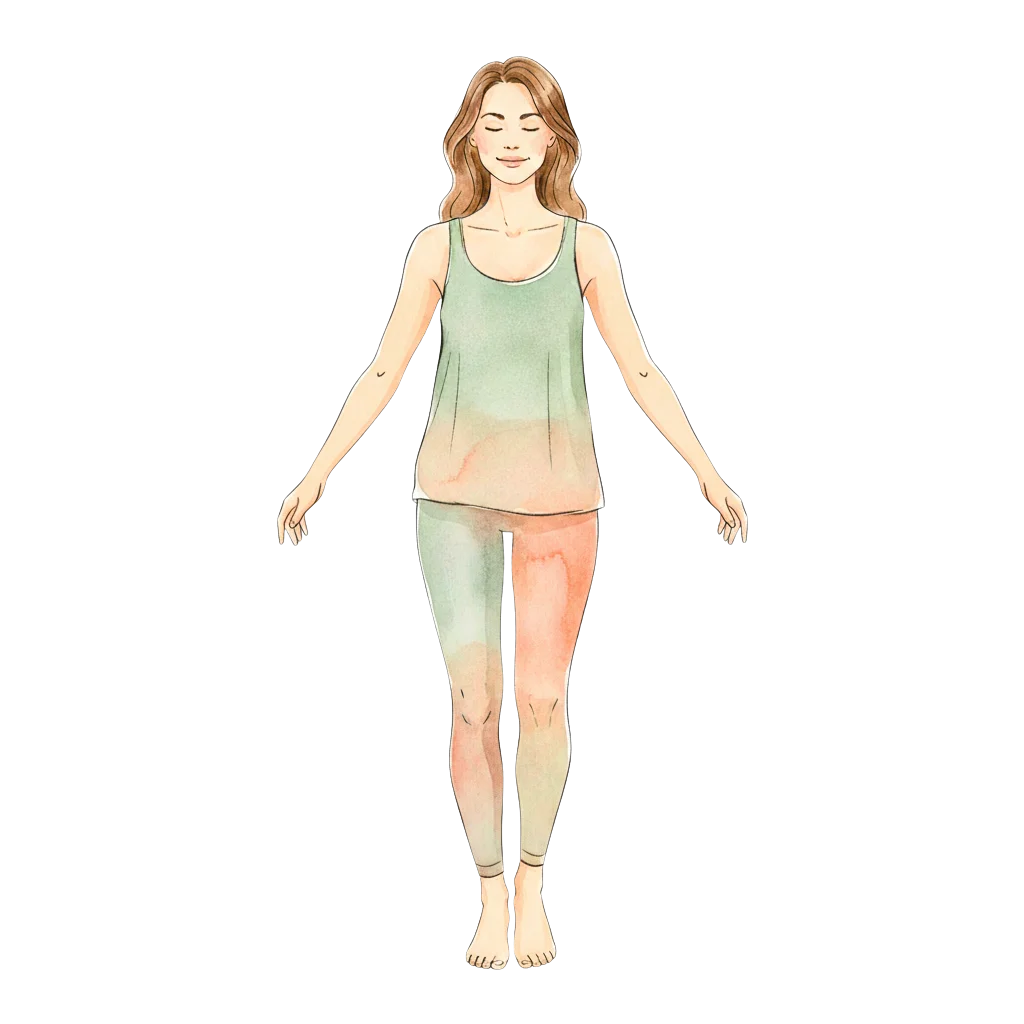
Start your protocolHow Perimenopause symptoms affects your body
Tap body zones to discover connected symptoms and related conditions.
Join 98+ women discussing perimenopause symptoms
Real experiences shared across Reddit, TikTok, and health forums
What was your very first sign of perimenopause?
What was your very first sign of perimenopause?
My 40s are fucking ruining everything
My 40s are fucking ruining everything
What are the first signs?
What are the first signs?
Reading others' stories is the first step. Join to share yours.
Community
A safe space for women navigating perimenopause symptoms
Frequently asked questions
Common questions about Perimenopause symptoms
How we research and fact-check
Every article on Wellls is researched using peer-reviewed medical literature, clinical guidelines, and real patient experiences from 10 online discussions.
Sources: We reference 49 PubMed-indexed studies, ACOG/NAMS clinical guidelines, and validated screening tools.
Review: Content is written by our editorial team, enriched from a medical knowledge base of 15,000+ sources. Evidence standards and clinical methodology guided by our Medical Advisory Board: Dr. Alexandra Rybakova and Dr. Alexander Rybakov, Lifestyle Medicine Physicians with 35+ years combined clinical practice.
This content is for informational purposes only and does not constitute medical advice. Our editorial standards · Medical advisory board
References
49 sources reviewed for this perimenopause symptoms guide
- 1.
- 2.Dr. Stephanie Faubion The New Rules of Menopause [Book]
- 3.
- 4.Dr. Mary Claire Haver The New Menopause [Book]
- 5.Dr. Lisa Mosconi The Menopause Brain [Book]
- 6.Dr. Louise Newson The New Perimenopause [Book]
- 7.Dr. Shahzadi Harper The Perimenopause Solution [Book]
- 8.The Menopause Transition: Signs, Symptoms, and Management Options [PubMed]
- 9.Harlow SD et al. Executive summary of the Stages of Reproductive Aging Workshop +10 [PubMed]
- 10.Prevalence and severity of symptoms across the menopause transition [PubMed]
History of updates
Current version (March 11, 2026) — Content reviewed and updated based on latest research
First published (March 9, 2026)
Explore related problems
Women who experience perimenopause symptoms often also deal with these
Your personalized plan is ready
You have spent three years googling your symptoms. You have read the Reddit threads at 2am. You have been told your labs are normal by doctors who tested the wrong things. Our Dr. Wellls can analyze your specific symptom pattern, tell you which tests to request, and help you prepare for the appointment that finally gets you answers. This is not generic advice. This is personalized guidance from a system trained on 14,000+ medical sources and designed specifically for women navigating the perimenopause transition.
4,400+ women tracked in the latest perimenopause research. Every protocol in this program is built on that evidence.
Free assessment · Takes 2 minutes · No account required
Medical disclaimer: This content is for informational purposes only and does not constitute medical advice, diagnosis, or treatment. Always consult a qualified healthcare provider for personal medical decisions. Content is based on peer-reviewed research and updated regularly. Learn about our editorial standards.