Back Health — Best Exercises for Lower Back Pain (Workout 1)
Exercise Breakdown
13 exercises in Workout 1
Warm-up5 exercises5m 32s
“If there are any particular parts of your spine that feel a little bit sticky, slow it down.”
“Push the tailbone backwards and the crown of the head forwards.”
“Open the mouth so that the spine can fully extend.”
“Literally bend the side of your body as you look over your shoulder.”
Strength4 exercises11m 6s
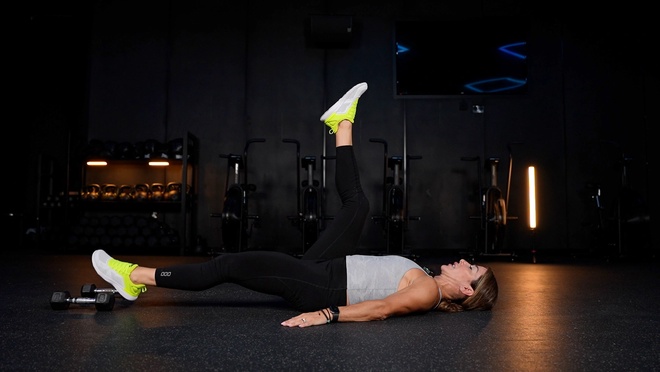
“Shin is parallel to the ceiling, and eyes are straight in front of you.”
“Is the pelvis rocking? Do we feel weaker on one side than the other?”
“Pushing the floor away... you are using your upper body strength.”
“If you're not feeling it in the core, push back into the core a little bit more.”
Flexibility1 exercise1m 39s
“Twisting is very, very important when we're working with the back.”
Cool-down1 exercise1m 31s
“Slowly and steadily, you roll up, one vertebrae at a time.”
pilates1 exercise2m 19s
“Think about a piece of string from your pubic bone to your belly button shortening.”
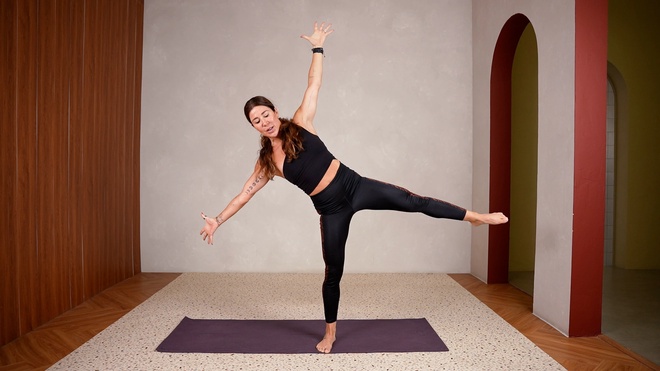
yoga1 exercise39s
Muscles Targeted
Primary
Secondary
Equipment & Modifications
Available Modifications
- Hands to shins or above the knees if less flexible
- Support the head with fingertips or keep palms on the floor
- Lift toes off for more hamstring activation
- Raise hands to ceiling for stability challenge
- Add a hip press with each extension
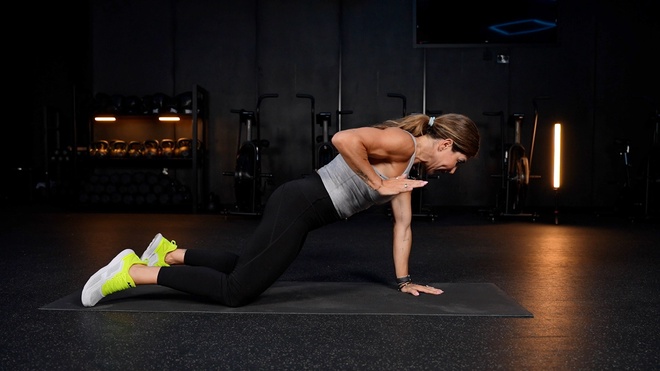
- Modified plank on knees
- Full plank on toes
- Alternating 20 seconds on toes/knees
- Reach arm out in front
- Wrap arm around the back
Coaching Highlights from Linda Chambers
“If there are any particular parts of your spine that feel a little bit sticky, slow it down — I tell every new client the same thing on day one: speed is not the goal here. Your spine has been compressed all day — give it time to decompress, one segment at a time.”
Form
“We always want to have full support between the torso and the lower body — I've seen women rush into bridges without setting up the connection first, and that's when the lower back takes over. Slow the set-up down. The set-up IS the exercise.”
Safety
“Push the tailbone backwards and the crown of the head forwards — creating length through the entire spine. Think of it like pulling taffy in two directions. Most people only think about one end. You need both.”
Form
“Modified plank on knees, full plank on toes, or alternating 20 seconds on toes and knees. Nobody gets a medal for collapsing at 40 seconds. Pick the version where your form stays clean for the full hold.”
Modification
Health Benefits
If you spend most of your day sitting and your lower back aches by 3 PM, this is your starting point — I designed this workout for women dealing with chronic non-specific lower back pain — the kind where nothing is structurally wrong but everything feels stiff and sore. Postpartum women rebuilding core stability and that pelvic floor connection will find the pelvic tilts especially useful. If you're in your 30s or 40s and your spine feels ten years older than the rest of you, this gentle, progressive 25-minute session meets you exactly where you are.
body pain
90% relevantImproved range of motion and joint lubrication; Enhanced body awareness and proprioception to identify and correct movement patterns; Strengthening of stabilizing muscles (e.g., core, glutes) to support painful areas; Reduction of muscle tension and fascial restrictions; Parasympathetic nervous system activation for pain modulation and stress reduction
administrative post
90% relevantposture correction; spinal decompression; muscle activation (deep core); stress reduction; improved circulation
chronic pain
60% relevantpain gate modulation; endorphin release; joint mobility improvement; muscle tension release
workplace safety
60% relevantimproving postural alignment to reduce strain from repetitive tasks or prolonged sitting; enhancing body awareness to identify and correct ergonomic inefficiencies; increasing flexibility and range of motion to prevent musculoskeletal injuries; strengthening core and stabilizing muscles to support the spine and joints; reducing muscle tension and stress accumulation from workplace demands
nerve tingling
60% relevantNerve gliding and flossing to improve nerve mobility and reduce compression; Gentle stretching to release muscle tension that may impinge nerves; Improved posture and body mechanics to alleviate nerve impingement; Core and pelvic floor strengthening (Pilates) to support spinal health and reduce nerve pressure; Mindful movement (Yoga) to reduce pain perception and promote relaxation
Relevant For
Frequently Asked Questions
What muscles does this back pain workout target?
The deep spinal stabilizers — erector spinae, multifidus, transversus abdominis. These are the muscles you can't see in a mirror but absolutely feel when they're not doing their job. Secondary work hits your hamstrings, glutes, and shoulders. A 2024 systematic review confirmed that core stability exercises targeting these specific muscles are among the best exercises for lower back pain. Most of my clients don't realize their deep core is this weak until we start pelvic tilts.
Do I need any equipment for this workout?
Nothing. Not a single thing. Every exercise in this 25-minute session is bodyweight-only, which makes it one of the most accessible lower back bodyweight exercises you can do at home. A yoga mat helps during floor work — pelvic tilts, bridges, plank — but a folded blanket on carpet works fine — I've had clients do this in hotel rooms on bath towels.
Is this workout suitable for beginners?
It's built for beginners — I start with gentle spinal mobility — forward folds, cat-cow — before we touch anything that resembles core strengthening exercises. Each movement has modifications: the forearm plank can stay on knees, the hip bridges skip the leg extension if that's too much today. Owen et al — published a network meta-analysis (JOSPT, 2022) showing this type of graded progression — mobility first, then stability — is the most effective approach for back pain. That's exactly how I structured it.
How long is this workout?
25 minutes. That includes a proper warm-up (forward folds, spinal roll-ups, cat-cow, lateral flexion) and cool-down (thread the needle, downward dog). The ACSM recommends 20-30 minutes of neuromotor and flexibility exercise, 2-3 times per week. So one session checks that box. No filler, no standing around.
Are there modifications available for this workout?
For every single exercise. The forearm plank? Knees, toes, or alternating 20 seconds on each — pick what lets you hold good form for the full duration. Hip bridges can drop the leg extension entirely. Forward folds allow hands to shins instead of the floor — I always say: the modification IS the exercise if it's where your body needs to be right now.
Is it safe to exercise with lower back pain?
For most chronic, non-specific lower back pain — yes, and the research is overwhelming on this. A 2024 umbrella review covering multiple meta-analyses found exercise therapy consistently beats rest and passive treatments for chronic low back pain. This workout uses gentle, controlled movements. Nothing ballistic, nothing heavy. But here's the honest part: if you have acute pain that woke you up last night, numbness radiating down your leg, or a recent injury, see your doctor first. Movement is medicine, but the right movement at the right time matters.
Can I do these exercises for lower back pain at home?
That's exactly what this was designed for. Zero equipment, enough floor space to lie down. Pelvic tilts, cat-cow, hip bridges, forearm plank — all of it happens in about two square meters. Stuart McGill PhD, who has spent decades studying spine biomechanics, advocates exactly this kind of daily home-based spinal hygiene: mobility first, then stability, then endurance. You don't need a gym for exercises for lower back pain at home. You need consistency.
How often should I do back exercises for pain relief?
The ACSM recommends core strengthening exercises 2-3 days per week. For active back pain management, I suggest daily gentle mobility work — the cat-cow and lateral flexion from this workout take about 4 minutes — combined with 2-3 full strength sessions per week. This workout pairs well with the other Back Health sessions for variety. What I tell my clients: frequency beats intensity every time when it comes to backs.
What is the best ab workout for lower back pain?
Forget crunches. The best ab workout for lower back pain trains stability, not flexion. This workout uses pelvic tilts, single leg tabletop crunches, and forearm planks — all of which light up the transversus abdominis and internal obliques at 40-60% maximal activation (that's from EMG studies, not guesswork) without crushing the lumbar discs. Traditional sit-ups generate far more spinal compression — I pulled sit-ups from my programming years ago, and not a single client has missed them.
Related Workouts & Topics
More from Back Health


More with Linda Chambers
Browse Exercise Collections
Helpful For These Concerns
About the Trainer

Linda Chambers
Back Pain Trainer
From: Back Health