Back Health — Best Exercises for Lower Back Pain (Workout 5)
Exercise Breakdown
11 exercises in Workout 5
Warm-up2 exercises2m 25s
“Drop the chin forwards, roll the shoulders forwards, slowly mobilizing one vertebrae at a time.”
“Breathe in when you lengthen and breathe out when you flex and shorten.”
Strength3 exercises7m 40s
“Think about pulling the inner thighs together.”
“Toes are always slightly higher than the knee. Try not to let the lower leg be lazy.”
“Flex your ankle. It's like you're trying to put a footprint on the ceiling.”
Flexibility3 exercises3m 29s
“Place your right hand on top of your right foot and turn towards the left.”
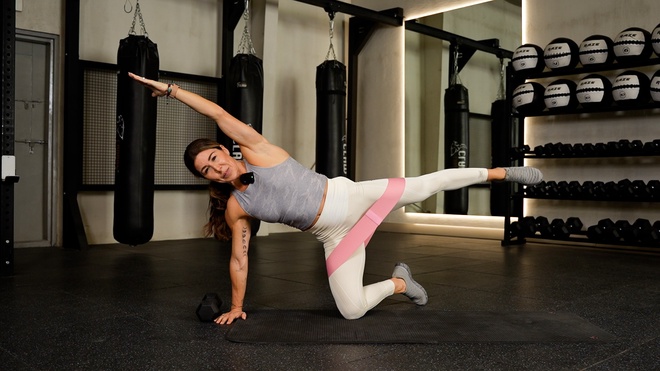
“As we bring the leg in, we lift the other leg, so it's kind of like a windmill.”
Balance1 exercise1m 29s
“Reach out on the diagonal, bring it back, and center.”
Cool-down1 exercise1m 25s
“Press the heels into the ground one at a time, stretching through the calves.”
pilates1 exercise2m 30s
“Think about pushing out through the fingertips, out through the toes.”
Muscles Targeted
Primary
Secondary
Equipment & Modifications
Available Modifications
- Move as slowly as you feel you need to if balance isn't quite there today
- Lift the toes if you wish or keep the feet flat
- Keep the knee slightly bent as you drop from one side to the other
- Go alternate if single leg is a little bit too much for you
- Alternate legs to work on stabilizers more
Coaching Highlights from Linda Chambers
“Drop the chin forwards, roll the shoulders forwards, slowly mobilizing one vertebrae at a time — I can usually tell within the first three roll-downs how someone's back is feeling today. Sticky at the thoracic junction? Tight through the hamstrings? The roll-down tells you everything before we've even gotten to the floor.”
Form
“Make sure that the spine is long, there's no excessive arching through that lower back. During bridges, the number one cheat is arching the lumbar spine to get higher. Don't. The height comes from the glutes. If your lower back is doing the lifting, your glutes have checked out.”
Safety
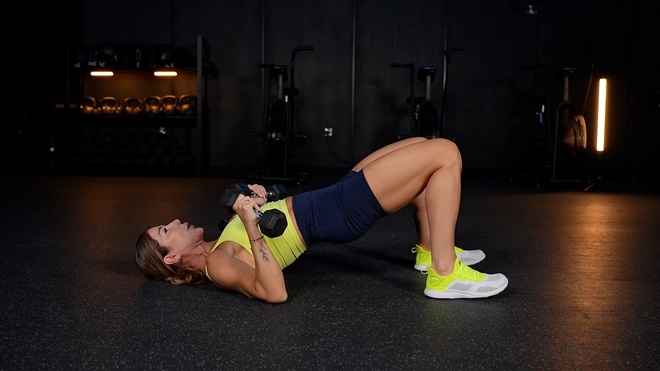
“Toes are always slightly higher than the knee — this ensures the glutes, not the hamstrings, do the lifting. It's a tiny adjustment that changes everything. Drop the toes below the knee and the hamstrings dominate. Keep them above, and suddenly your glutes have to show up. Most people have never felt their glutes work properly during a bridge until I give them this cue.”
Form
“Think about pulling the inner thighs together — activating the adductors stabilizes the pelvis from the inside. It sounds counterintuitive. You're doing a glute exercise, why are we talking about inner thighs? Because the pelvis is a ring. Glutes pull from the outside, adductors stabilize from the inside. You need both to protect the lower back.”
Motivation
Health Benefits
If you've been sitting for years and your glutes have essentially gone to sleep, this is your wake-up call. Gluteal amnesia is not a joke diagnosis — it's what happens when the gluteus maximus and medius stop firing properly after prolonged sitting, and the lower back picks up the slack. Glute bridges, single-leg bridges, and donkey kicks reactivate those muscles directly. Women experiencing lower back and hip pain from tight hamstrings will benefit from the standing forward fold with twist and dynamic leg swings. And if you suspect one side is weaker than the other — the single-leg glute bridge will confirm it within three reps. Postpartum women rebuilding the glute-to-pelvic-floor connection will find this especially relevant.
body pain
90% relevantImproved range of motion and joint lubrication; Enhanced body awareness and proprioception to identify and correct movement patterns; Strengthening of stabilizing muscles (e.g., core, glutes) to support painful areas; Reduction of muscle tension and fascial restrictions; Parasympathetic nervous system activation for pain modulation and stress reduction
administrative post
90% relevantposture correction; spinal decompression; muscle activation (deep core); stress reduction; improved circulation
chronic pain
60% relevantpain gate modulation; endorphin release; joint mobility improvement; muscle tension release
workplace safety
60% relevantimproving postural alignment to reduce strain from repetitive tasks or prolonged sitting; enhancing body awareness to identify and correct ergonomic inefficiencies; increasing flexibility and range of motion to prevent musculoskeletal injuries; strengthening core and stabilizing muscles to support the spine and joints; reducing muscle tension and stress accumulation from workplace demands
nerve tingling
60% relevantNerve gliding and flossing to improve nerve mobility and reduce compression; Gentle stretching to release muscle tension that may impinge nerves; Improved posture and body mechanics to alleviate nerve impingement; Core and pelvic floor strengthening (Pilates) to support spinal health and reduce nerve pressure; Mindful movement (Yoga) to reduce pain perception and promote relaxation
Relevant For
Frequently Asked Questions
What muscles does this back pain workout target?
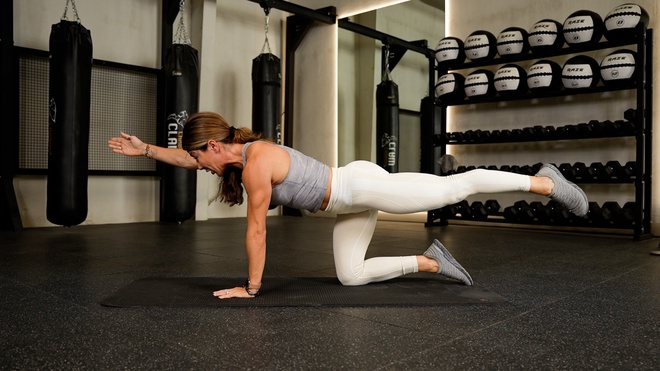
Glutes and hamstrings — the muscles underneath your lower back that are supposed to be doing the heavy lifting. Bilateral glute bridges, single-leg glute bridges, and donkey kicks all target the gluteus maximus and medius. EMG research shows single-leg bridges produce 50-70% maximal gluteal activation. The swimming prep and bird-dog target the erector spinae and multifidus up top. Together, these muscles form the posterior chain — your body's natural lumbar support system, working from below.
Do I need any equipment for this workout?
Nothing at all. 11 exercises, all bodyweight, all doable at home in a small space. These are lower back bodyweight exercises in the truest sense — your body is the only resistance you need. A mat is optional for comfort — I've done this workout in a hotel room with a bath towel under my hips.
Is this workout suitable for beginners?
Yes, and the progression is built in. We start with bilateral glute bridges — both feet on the ground, sharing the load. Then single-leg bridges, where one side has to do all the work alone. If the single-leg version is too much today, go back to bilateral. That's not failure. That's your body telling you exactly where it is — I always say: the bilateral bridge is the honest version for most beginners.
How long is this workout?
20 minutes. 11 exercises — standing warm-up, floor-based strength block, cool-down. Efficient enough to fit into a lunch break. Short enough that you'll actually do it. The ACSM says 20 minutes minimum for neuromotor exercise benefits, and this hits that mark without a single wasted minute.
Are there modifications available for this workout?
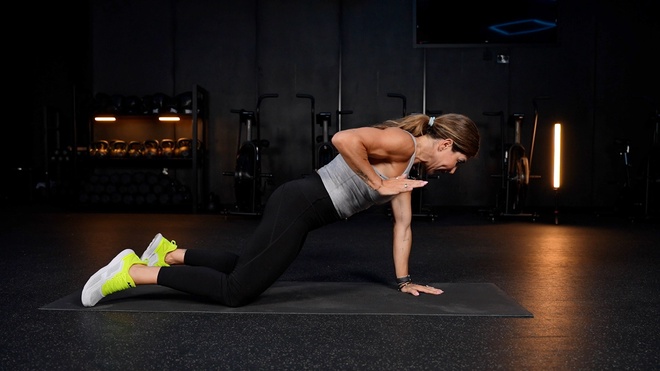
Every exercise. Single-leg glute bridges go back to bilateral if one leg isn't ready. Bird-dog diagonal reach simplifies to standard opposite arm-leg. Standing forward fold allows bent knees — I actually prefer it that way for tight hamstrings, because straight-legged forward folds can strain the lumbar spine. Dynamic leg swings shrink in range — I adjust pacing throughout based on what I see.
Is this workout safe for people with back pain?
This approach is specifically designed for back pain, because the problem with most sore backs isn't the back itself — it's the glutes underneath it. When glutes are weak, the lumbar erectors compensate during every hip extension: walking, standing up from a chair, climbing stairs. The best exercises for lower back pain address the cause, not just the symptom — and weak glutes are the cause more often than people realize. A meta-analysis of therapeutic exercises confirmed that glute bridges and donkey kicks generate high gluteal activation while keeping spinal load low — I cue neutral spine and pelvic control throughout. The back rests while the glutes work. That's the point.
Why do glute bridges help with pain in lower back and right side of hip?
That specific pattern — pain in lower back and right side of hip — usually means one side of your posterior chain is weaker or tighter than the other. Walking, standing, sitting with legs crossed — all of it adds up to asymmetry. This workout addresses it head-on: bilateral bridges first to establish the pattern, then single-leg bridges to expose exactly where the imbalance lives. Three reps of single-leg bridges on each side will tell you which glute has been taking a vacation. Donkey kicks add hip extension strength. The bird-dog diagonal reach trains pelvic stability so the pelvis stops shifting to compensate. If the right hip pain comes from piriformis or gluteal weakness, these exercises target it directly.
How do glute bridges provide lumbar support for back pain?
Strong glutes take hip extension away from your lower back. Standing up, walking, stairs — those movements should be powered by the gluteus maximus. When glutes are weak from years of sitting, the erector spinae compensate. That's lumbar overload, and it's the most common mechanism I see for back pain lumbar support problems. Glute bridges retrain the gluteus maximus to fire during hip extension. EMG data shows bilateral bridges activate at 50-70% MVC; single-leg pushes even higher. This workout builds natural lumbar support from the bottom up. Not a cushion you strap to a chair — actual muscular support.
What is the difference between glute bridges and single-leg glute bridges?
Bilateral bridges share the load between both legs. They're the foundation — good form, baseline strength. Single-leg bridges isolate each side, and that's where it gets revealing. Research shows single-leg bridges generate roughly 30% more gluteal activation per side because the working glute has to stabilize the pelvis alone. No cheating, no compensation — I use both in this workout: bridges to build the pattern, single-leg to challenge it. If one side drops or wobbles more than the other, that's not a problem — that's information. That's the weak side your lower back has been covering for.
Related Workouts & Topics
More from Back Health


More with Linda Chambers
Browse Exercise Collections
Helpful For These Concerns
About the Trainer
Linda Chambers
Back Pain Trainer
From: Back Health