Back Health — Best Exercises for Lower Back Pain (Workout 2)
Exercise Breakdown
11 exercises in Workout 2
Warm-up4 exercises5m 33s
“Vertebrae by vertebrae, slowly roll ourselves all the way down.”
“Exhale, pull in, look at the belly button and push the floor away.”
“Look over one shoulder, and then we look over the other.”
“Flexing as we roll down, and then we're extending as we sit back up.”
Strength2 exercises6m 35s
“We want the rotation to come from thoracic and into the hips.”
Flexibility2 exercises1m 24s
“Drop your knees over to one side, turning your head in the opposite direction.”
“Take hold of the foot and the ankle.”
pilates2 exercises5m 40s
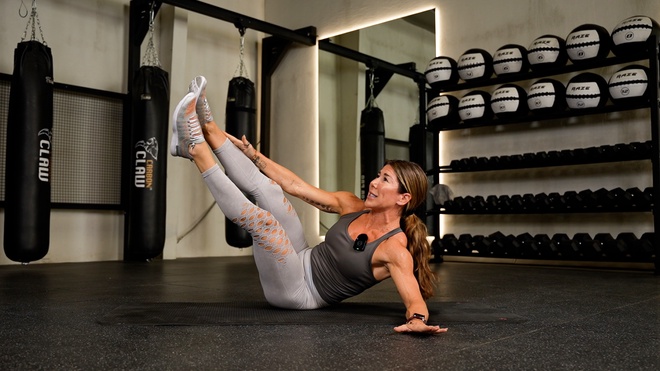
“Toes higher than the knees so that we are actually working the core.”
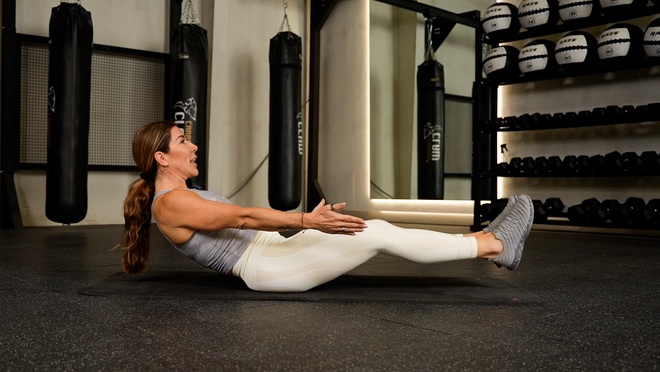
“Nod the chin, peel the shoulders, hold, and then slowly roll back down.”
yoga1 exercise30s
“Tuck the toes, push back into your downward-facing dog.”
Muscles Targeted
Primary
Secondary
Equipment & Modifications
Available Modifications
- keep hands close to the legs for assistance
- straighten legs out in front
- place hands on knees for assistance
- alternating sides for more focus on stability
- add ankle weights
- hold light hand weights
- perform from the knees
- perform on toes with wider feet
- knees bent
- legs straight
- hands sliding on thighs for assistance
Coaching Highlights from Linda Chambers
“Drop your knees over to one side, turning your head in the opposite direction. This counter-rotation is something people skip constantly. Don't. The lower back craves this opposing pull — it's how we decompress the segments that got loaded during the strength work.”
Form
“Don't have that excessive arch through the lower back — I see this every single session with new clients. When the back arches during dead bug, it means the core checked out and the hip flexors took over. Reset. Flatten the lower back to the mat. Start again.”
Safety
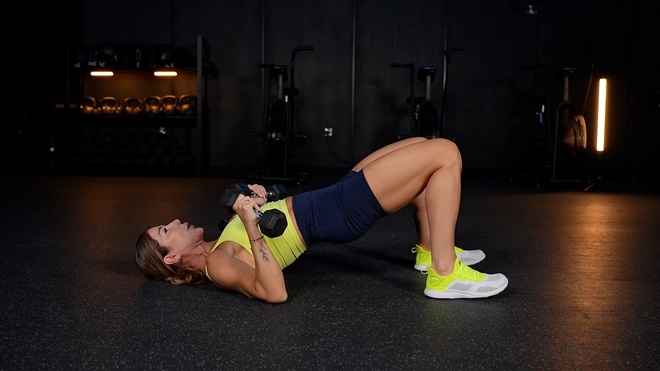
“Stretching the glutes is just as important as working the glutes — I know — it doesn't feel productive. It doesn't burn. But the figure four stretch after those bridges is what keeps your piriformis from screaming at you tomorrow morning.”
Motivation
“Toes higher than the knees so that we are actually working the core — not just moving the legs around. This is the single most important cue in dead bug. If your toes drop below your knees, the exercise changes completely. The core stops working and the legs just swing.”
Form
Health Benefits
This one is for women who sit all day and feel that dull ache in the lower back and right side of hip by evening. The bird dog and dead bug train each side independently — so if one hip is tighter or weaker than the other, you'll know within the first set. Women recovering from diastasis recti will appreciate that every core strengthening exercise here avoids excessive abdominal pressure. And if you've been told you have piriformis tightness or sciatica-like symptoms, the figure four stretch at the end goes directly after that spot.
body pain
90% relevantImproved range of motion and joint lubrication; Enhanced body awareness and proprioception to identify and correct movement patterns; Strengthening of stabilizing muscles (e.g., core, glutes) to support painful areas; Reduction of muscle tension and fascial restrictions; Parasympathetic nervous system activation for pain modulation and stress reduction
administrative post
90% relevantposture correction; spinal decompression; muscle activation (deep core); stress reduction; improved circulation
chronic pain
60% relevantpain gate modulation; endorphin release; joint mobility improvement; muscle tension release
workplace safety
60% relevantimproving postural alignment to reduce strain from repetitive tasks or prolonged sitting; enhancing body awareness to identify and correct ergonomic inefficiencies; increasing flexibility and range of motion to prevent musculoskeletal injuries; strengthening core and stabilizing muscles to support the spine and joints; reducing muscle tension and stress accumulation from workplace demands
nerve tingling
60% relevantNerve gliding and flossing to improve nerve mobility and reduce compression; Gentle stretching to release muscle tension that may impinge nerves; Improved posture and body mechanics to alleviate nerve impingement; Core and pelvic floor strengthening (Pilates) to support spinal health and reduce nerve pressure; Mindful movement (Yoga) to reduce pain perception and promote relaxation
Relevant For
Frequently Asked Questions
What muscles does this back pain workout target?
This session goes deep. Bird dog trains the multifidus — the small muscles that run alongside each vertebra and keep your spine stable when you reach, twist, or bend. Dead bug targets the transversus abdominis, your deepest core layer. Forearm plank hip dips light up the oblique system. If you're looking for an ab workout for lower back pain that won't wreck your spine, this is it — no crunches, no sit-ups. Stuart McGill PhD put bird dog in his 'Big 3' for spinal stability for a reason: it trains contralateral coordination while keeping the lumbar spine completely neutral. That's hard to achieve with most exercises.
Do I need any equipment for this workout?
No. Bodyweight only. All lower back bodyweight exercises, all doable in a small space at home. A mat is nice for the dead bug and supine twist — your shoulder blades will thank you — but it's not required.
Is this workout suitable for beginners?
Yes, and I built it with a deliberate ramp. We start standing with roll-ups and cat-cow, then spinal waves — all gentle mobility. By the time we get to bird dog and dead bug, the spine is warm and the nervous system is ready for core strengthening exercises. Each exercise has clear modifications: dead bug can use a smaller range, the plank drops to knees. Nobody should be white-knuckling through anything here.
How long is this workout?
20 minutes flat. 11 exercises from spinal mobility to core strength to flexibility. The ACSM recommends 20-30 minutes of neuromotor exercise 2-3 times per week. This session hits that mark without eating your entire lunch break.
Are there modifications available for this workout?
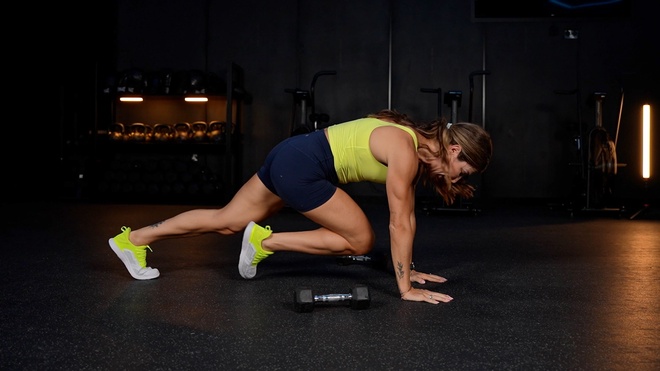
Every exercise. Bird dog can go single-arm or single-leg only if the full version wobbles too much. Dead bug range of motion can shrink — keep the limbs closer. Forearm plank hip dips drop to knees, or swap to a static plank hold if the rotation is too much. The figure four stretch can use a wall for foot placement — I cue all of these in real time.
Is this workout safe for people with back pain?
This workout was designed specifically for back pain. Bird dog and dead bug are classified as motor control exercises — a 2024 meta-analysis confirmed they're among the best exercises for lower back pain, specifically because they retrain neuromuscular coordination rather than just building brute strength — I cue neutral spine throughout. No sudden movements, no loaded flexion. That said, if you have acute pain, a disc herniation, or active sciatica shooting down your leg, check with your doctor before starting.
Can I do these exercises for lower back pain at home?
This is a home workout, start to finish. Bird dog, dead bug, spinal waves, forearm plank hip dips — zero equipment, minimal space. And here's what the research says: home-based core stability programs are as effective as supervised gym programs for chronic lower back pain when you actually do them 2-3 times per week. The hard part isn't the exercises. It's showing up consistently.
What helps pain in lower back and right side of hip?
That asymmetric ache — lower back and right side of hip — usually points to piriformis tightness or gluteal weakness on one side — I see it constantly in women who carry bags on one shoulder or cross the same leg every time they sit. This workout addresses both: bird dog and dead bug train each side independently, so the imbalance reveals itself immediately. The figure four stretch goes directly after the piriformis and deep hip rotators. A meta-analysis of gluteal exercises found that contralateral movements like bird dog produce the highest gluteus medius activity — which is what stabilizes your pelvis and reduces that one-sided strain.
What is the difference between bird dog and dead bug for core strengthening?
Both are anti-extension core strengthening exercises, but the position changes everything. Bird dog is on all fours — gravity pulls your belly toward the floor, so you're training the posterior chain (glutes, lower back, shoulders) to resist that pull while extending opposite limbs. Dead bug flips you onto your back — now the core has to prevent the lower back from arching off the floor as you extend your limbs away. One trains from the back, one from the front — I use both in this workout because a spine needs 360-degree support. A systematic review of anti-rotation exercises confirmed that combining prone and supine positions gives the most complete stabilizer training.
Related Workouts & Topics
More from Back Health


More with Linda Chambers
Browse Exercise Collections
Helpful For These Concerns
About the Trainer

Linda Chambers
Back Pain Trainer
From: Back Health