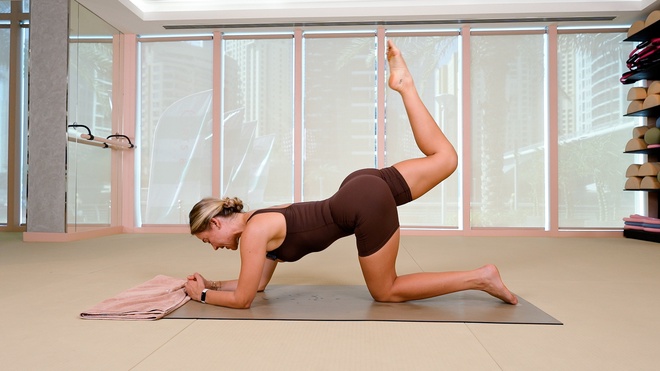
Exercises for incontinence: glute bridges, bird dogs, Kegels, Pilates. For bone density: squats, lunges, resistance training. Both conditions respond to exercise during perimenopause.
Exercises for Incontinence and Bone Health
This page exists because two things happen during perimenopause that nobody prepares you for. Your bones get weaker.
Workout 10
Jessica Casalegno
For informational purposes only. Consult a healthcare provider before starting any exercise program.
Exercises
20 exercises for exercises for incontinence and bone health
Showing 12 of 20 · 8 more
Video workouts
Professional trainer-led workouts for exercises for incontinence and bone health
Workout 2
Workout 4
Workout 3
Workout 9
Workout 8
Workout 4
Workout 1 – Six Rounds Bodyweight
Why this matters in perimenopause
Estrogen is the scaffolding molecule. It maintains bone mineral density. It preserves collagen in connective tissue. It supports the structural integrity of your pelvic ligaments. When it drops, all three systems weaken simultaneously.
The bone loss numbers are stark. Women lose up to 20% of their bone density in the five to seven years following menopause. A meta-analysis of exercise and bone health found that impact and resistance exercises improved lumbar spine and femoral neck BMD in postmenopausal women. The effect was dose-dependent: more intense exercises produced larger improvements.
Pelvic floor research is equally compelling. A systematic review and meta-analysis found pelvic floor muscle training reduced urinary incontinence symptoms in postmenopausal women with moderate to large effect sizes. But the interesting finding was that combined exercise, meaning pelvic floor work plus general fitness, produced better outcomes than pelvic floor training alone.
A randomized controlled trial comparing Pilates to targeted pelvic floor exercises found equivalent incontinence improvements. That matters because many women cannot correctly activate their pelvic floor in isolation. Whole-body exercises that include the pelvic floor as part of the kinetic chain may be more practical for most women.
The exercises for incontinence and bone health on this page are designed to address both issues simultaneously. Because in perimenopause, they are the same problem: estrogen-dependent tissue losing its structural support.
Your trainers
Certified professionals guiding your exercises for incontinence and bone health journey

Sophie Jones
94 workouts on Wellls


Frequently asked questions
Common questions about exercises for incontinence and bone health
Related collections
Keep exploring targeted exercise programs
Start your exercises for incontinence and bone health program
Get access to all workouts, personalized exercise plans from Dr. Wellls, and progress tracking.
Join 1,200+ women training with expert guidance